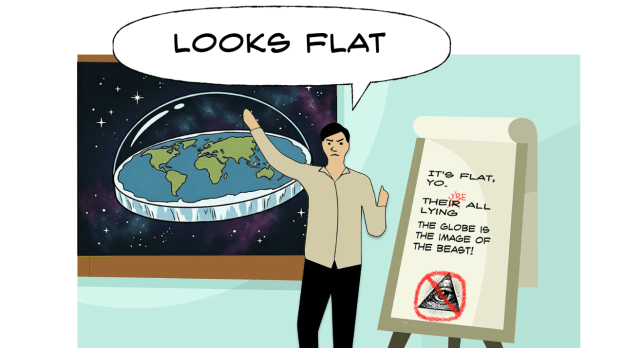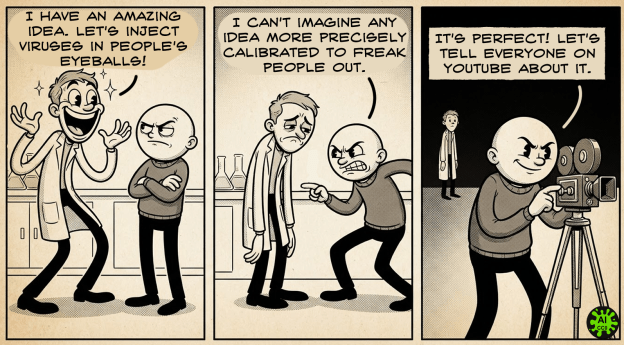
A crude illustration of a man showing a slide show illustration of a flat earth. He has a misspelled set of talking points.

How to (not) Argue with Anti-Vaxxers

This post is also available in video form on Youtube: https://youtu.be/eojTc0Hu0Fg

Are mRNA vaccines safe and effective?

People argue about the mRNA vaccines. Are they safe and effective? And if people get it wrong, should we bother trying to convince them? This has become a contentious (and political) issue. I’m Dr. Peter Allen. I earned a PhD in bioanalytical chemistry. I am not employed by any company with an interest in vaccines, and this video represents my personal thoughts and opinions. I want to share some 2026 research on the vaccine safety. Thankfully we don’t need a lot of expertise to understand the broad strokes of this recent study. I want to examine what it means to the anti-vax position.

Frankly, this is the kind of research that is so clear, so understandable, that it should settle the arguments. This is how an evidence-based argument is supposed to work.

The Study: Do vaccinated people die more or less often?

The research was conducted in Norway. It wasn’t funded by “big pharma” and wasn’t influenced by the US government. They evaluated the vaccine in the broadest, simplest way: are people who are vaccinated with the mRNA COVID‑19 vaccine more or less likely to die?

Dahl, J. et al. COVID-19 mRNA Vaccination and All-Cause Mortality in the Adult Population in Norway during 2021-2023: A Population-Based Cohort Study. BMJ Public Health 2026, 4 (1), e001859. https://doi.org/10.1136/bmjph-2024-001859.

The Results: Vaccinated individuals had significantly lower death rates

The methods are straightforward. They collected data form the Norwegian health system’s medical records. They collected vaccination status (and dates) and date of death (where applicable). Then they counted.

Of the people who never got a vaccine, how many died from 2021–2023?

Of the people who did get one or more vaccinations, how many died from 2021–2023?

Which number is bigger?

They broke it down into age and risk groups to make an apples-to-apples comparison. They included people in the vaccinated category immediately after vaccination.

Overall, the rate of deaths per 100,000 people went down by more than 20% in the vaccinated group.

Let’s look at the 65 years or older group (the other age groups had fairly proportionate numbers). Take 100k vaccinated people for one year and compare to 100k unvaccinated people. In the studied timespan, 3621 VACCINATED people died and 4780 UNVACCINATED died. To be clear: that is more than 1100 extra deaths in the unvaccinated group per year.

That’s not hard math. 4780 is greater than 3621. I want to be in the category with the 1000 fewer deaths.

You can calculate a risk ratio: how much less risk do vaccinated people have? And across the age groups, it’s about 0.7 to 0.8, meaning that they only have about 70-80% chance of dying. If you do some statistical adjustments to correct for people’s risk categories, the vaccine looks even better (risk ratios of 0.37 to 0.48, or a reduction in risk of death by more than half).

These adjustments are there to correct for trends: educated people and people with preexisting health conditions tend to get vaccinated at higher rates. Those population trends will bias the raw data. The examples I gave tend to cancel, but they have to be carefully weighed. That is complex, and it could be a source of critique.

But we don’t need fancy statistics because the result is big enough to stand out from the noise.

Anti-vaxxers claim:

  • The vaccine causes many or most people to die
  • The vaccine causes turbo-cancer
  • The vaccine causes terrible side effects that are much worse than COVID‑19
  • Essentially, that the vaccine is a terrible, risky poison

Less sensational claims:

  • The vaccine carries a risk of side effects like myocarditis
  • Those risks may outweigh the risk of not getting the vaccine

If the anti-vaxxers were right, these numbers would look very different.

There are three cases:

  1. Vaccinated deaths > Unvaccinated deaths

    • That’s consistent with the vaccine being poison
    • It’s what you would expect if the vaccine caused turbo cancer
    • Consistent with the vaccine being unsafe and ineffective
  2. Vaccinated deaths ≈ Unvaccinated deaths

    • Consistent with the risk of serious complications being similar to COVID‑19
    • Consistent with the vaccine being safe but ineffective
  3. Vaccinated deaths < Unvaccinated deaths

    • The only condition where the vaccine should keep its regulatory approval
    • Consistent with the vaccine being safe and effective

We got the third case. This is as clear an outcome as you could hope for in this kind of study. It’s not fully proving causation (it’s an observational study, not a randomized placebo controlled clinical trial, which have also been done). But it does disprove the anti-vax position. There were no conflicts of interest, clear sources of data, obvious and unambiguous result, no close calls requiring careful statistical analysis.

Vaccines are safER and MORE protective

Are vaccines safe and effective? Yes. Is vaccination 100% safe and 100% effective? No, and nobody should claim that; it’s safER and MORE effective than NOT getting it. If the options were no-vaccine, vaccine, and Thanos-snapping the virus out of existence, take option 3! But we don’t have option 3. Option 2 is better than option 1. That’s what this paper says, independently from all the other safety and efficacy trials (which all also say the same thing).

It’s not often in science that you get a result this clear, this simple, that requires so little expertise to understand. It’s counting. They counted. The vaccine did its job. This is the perfect, purest, one-line answer to the concerns of the anti-vaxxers.

It’s a shame it won’t matter.

This Won’t Convince Anti-vaxxers

For the anti-vaxxers, there is no evidence that will satisfy. They are not available to be convinced. We could follow 100 million or 6 billion (the current total number of people vaccinated) instead of 4.6 million people. We could zoom in on every group, every timescale, every possible outcome. There is no standard of proof that can overcome determined contrariness.

That’s the key question: "what would change your mind?"

The answer is: "nothing you could ever do."

Scientific skepticism is not contrarianism

If you’re in a real life argument, you can literally pose that question. "What evidence would convince you?" The response should guide the next step. If there’s a good faith standard, or openness to one, you have an inroad. You can try to meet the standard, or suggest what a reasonable standard might look like. If the standard is impossible ("nothing could convince me" or "bring back my cousin who died after he got the jab"), it may be best to disengage.

Because that is how we know that the anti-vax movement is anti-science. If there is no practical condition that would change their mind, they are not doing scientific skepticism. That is the key difference between being skeptical and being belligerent. Skepticism says we should absolutely design and run these experiments, that we should take nothing on faith, that drug makers must be held accountable to standards of safety and effectiveness. That’s good – that’s scientific. Belligerence says that no matter how clearly the data contradict the preferred position, stick to it anyway:

Truth is the position we maintain until our enemies are silent.

When belligerent people demand more evidence, more experiments, larger studies, they are doing something different than skeptical scientists. They may frame their position as valuing evidence… but the real point is to obtain the rhetorical concession that the matter is not yet fully settled. And if the matter is not fully settled, they can claim that it is a matter of opinion.

In scientific disagreements, both sides can describe what evidence would change their mind. This is not that.

Flat earth videos got traction with the algorithm a few years ago. The central premise of the flat earth movement is "my anecdotes are as good as your expertise." More specifically, "my personal experience (looks flat!) and untrained intuition (math’s for eggheads!) are just as good as your precision data, calculations, and track record of verifiable quantitative predictions." That premise appeals to flat-earthers because it is license to believe… well, whatever they want to believe. And that license (along with the seductive promise of ‘hidden knowledge’) is enough to suck in an audience.

The anti-vax position has the same basic argument.

Why Engage Anyway? (For the Observers)

If you are in a position to talk about science with an anti-vaxxer, this is critical to understand: their belligerent contrariness limits what goals are achievable. If there is no condition that would convince your interlocutor, then the only reason to engage is to clarify the matter for observers. Engagement will almost never convince flat-earthers or anti-vaxxers. But may be worth taking the time to help an audience find better ideas.

Productive work in science and science communication requires building and maintaining communities and institutions. Confronting anti-science is one way to communicate to the quiet majority who may be watching: that science is reliable; that, at least in this case, the data are clear; that evidence-based reasoning is a powerful tool for human progress.

The Norwegian vaccine data are as clear as we could ask for. But the anti-vax movement wants nothing to do with data. Their belligerent disagreement is founded in conviction and rhetoric. Science communicators should go forward knowing what they are up against.

The Strength of Science: It Is fallible

I know some people will think I am saying science is infallible, that people should just believe "settled science" on the basis of scientific authority. I am not saying that; science is always provisional, always a work-in-progress. Science is always falsifiable. It is always contingent on future findings. That position seems rhetorically weaker.

But that is a feature, not a bug. Staking claims that can be invalidated by future measurements is dangerous. "This vaccine is safer than nothing, more effective than nothing" is a claim that people all over the world will question, measure, and hold up to scrutiny. It is a social and legal claim with heavy liabilities.

The anti-vax position is entirely unaccountable. It is based on anecdote and untrained intuition. We don’t fly in airliners built that way (without rigorous engineering standards). We don’t build bridges that way (without models and systematic testing). We don’t perform medicine that way. We trust real expertise.

The Norwegian study can be tested, repeated, falsified. These properties make it (and science like it) trustworthy. It’s not the prestige of their institution or their degrees. It’s not consensus with other experts. It’s not the sensationalism of their story. The vaccine reduced the number of dead people. They counted. That claim is accountable. That is what gives it scientific authority.

Understand the real purpose of engagement

If someone rejects the result and if they can’t name the conditions that would convince them, then they are not engaging in science.

Modeling scientific principles (and pointing out when anti-science actors operate outside of them) is the role of scientists. Science is never perfectly certain. It is defined by constant refinement and correction. That idea is worth spreading it to the non-scientists watching from the sidelines even if we never convince an anti-vaxxer.

And also, a bunch of them are just bots.

Broniatowski, D. A. et al. Weaponized Health Communication: Twitter Bots and Russian Trolls Amplify the Vaccine Debate. Am J Public Health 2018, 108 (10), 1378–1384. https://doi.org/10.2105/AJPH.2018.304567

Iron Battery 3.0 is Published!

Here’s the Paper: https://doi.org/10.1016/j.ohx.2025.e00629

The youtube version of this post is live https://youtu.be/ojolTZqfv-k

I’ve been working on the all-iron battery for eight years now. That feels wild to me. I’m happy to announce that version 3.0 is published! This paper is absolutely Dipak Koirala’s work more than mine. The newest incarnation of the Iron Battery is significantly more powerful than the previous version; it can completely discharge in ~10 hours (still slow compared to a lithium ion, but now in a practical range). To get there, we did 3 major changes:

  • Commercial membrane
  • Improved electrolyte and paste material
  • Soluble electrochemical mediators

First, a recap.

Continue reading

Which is more important: Diet or Exercise?

I just posted a new video:
https://youtu.be/KHY5XfMfdig

This post is the text version of that video. I didn’t send my last blog by email (I want to limit emails to one per month). In that last blog post, I linked to 3 videos. In case you missed them, I worked on two vlogs about burning Iron:

Attempt 1: Classic demo and solid oxidizer failure to ignite:
https://youtu.be/46YlW8qjp_c

Attempt 2: Steel wool burning in pure(ish) oxygen:
https://youtu.be/SURy8xRsRp4

And a video essay about robotics and automation:
https://youtu.be/TisXw8zS5r0

This latest work is a bit of a rant about a research rabbit hole. I was trying to ask what seemed like a simple question. Which is more important to longevity: diet or exercise? That seems pretty straightforward. I was surprised to find that it was almost impossible to get a clear comparison between two effects.

And then I found this study by Atefatfar et al. (2023). This study examined all four possible cases of the good/bad diet versus exercise/no exercise. I expected them to have similar, additive effects. But that’s not what they found.

Continue reading

Video essay on Robots (plus a DIY chemistry demo)

I managed to post three videos since my last update.

A vlog about burning Iron: https://youtu.be/46YlW8qjp_c

Burning Iron Attempt 2: pure-ish oxygen: https://youtu.be/SURy8xRsRp4

A video essay about robotics and automation: https://youtu.be/TisXw8zS5r0

The slightly expanded essay is below for your reading pleasure.

Continue reading

Aluminum is Wealth and Knowledge is Better than Gold

This post is also available in video form: https://youtu.be/pXXad5FmkiU

Aluminum is wealth. That sounds strange – it’s cheap, and it’s a recent invention. But the fact that we can all get use (goods and services) because of things made of aluminum is a kind of wealth. And it’s an example of a bigger principle. When someone tells you something is rare or scarce and equates that to value, remember this. Value comes from enabling more people to enjoy something, not from preserving its exclusivity.

Continue reading