Monthly Archives: February 2017

Experience with the open qPCR

The Allen Lab acquired an open qPCR instrument about a year ago. We were on the waiting list for a year, but they delivered. It’s about the same size as a conventional thermocycler, but it does more. It has blue LED illumination inside the heated lid and a green light sensor below. The result is that you can track fluorescence as you thermocycle. The key patents on qPCR just expired so I think they are safe from major litigation.
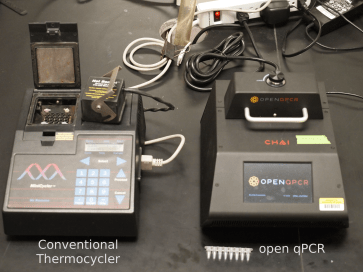
P2091784.png

The instrument’s software is open and quite well designed. You connect to it with a USB cable and then use a browser to connect to its internal software. Once it is running, it doesn’t seem to need the PC connection.

It can do conventional real time PCR as well as melt curve analysis. I have been using EvaGreen dye but I suspect that it would work with SyBr Green or Syto9. I’ve read good things about syto9.

My application has been to use qPCR instead of cyclecourse PCR for my students’ aptamer selections. We also used it to verify the DNA on the surface of microparticles. We can go down to about 10,000 molecules (probably limited by cheap plasticware that adsorbs some DNA; lo-bind plastic might lower detection limits further).

I did have to do a hard reset once after a failed update, but for the most part it has been a reliable instrument.

Fake news, fake threats, and marketing

I avoid the news like the plague but I do like zombie stories. I’ve been thinking about why zombie stories are so popular in American culture. Cracked has some funny hypotheses (excitement, free stuff, simple choices, immediate promotion to head honcho). I think all of those are part of it. I also think that zombies are the perfect example of fake news style marketing.

Robert Anton Wilson warned us of how news could be used for marketing. He made up a conspiracy he called the fnords. In the Illuminatus! Trilogy, the word “fnord” is hidden in all sorts of text – news especially. We have been trained not to see the fnords. We ignore them at a basic psychological level so they are essentially invisible. But they make us feel scared and apprehensive. Everything you see and read has fnords hidden all over, especially the news. The only exception is advertising. Advertising is our one relief from the relentless attack. This encourages consumerism.

Zombies are the same thing. They represent all the fake threats that haven’t happened, but that we sense might happen. And these fake threats are really good marketing.

Yesterday, despite my best efforts, I ran into a “news” report about a new and worsening crisis at the Fukushia Diichi power plant. It was garbage. No, the reactor is not falling into the ocean. It’s as stable as ever. Yes, it is still dangerous to go in. Yes, it will be an expensive clean-up. Recent assessments indicate it might be even more expensive than earlier estimates.

So why make stuff up? Why put “Japan declare state of emergency as Fukushima reactor 2 falls into the ocean” as a caption on an image?

Ads. The original fake story has ads plastered all over. How to win the lottery! Photoshopped pics of Emma Watson! You won’t BELIEVE what happens next! Fast relief from all the anxiety we JUST CAUSED! Click! Click and Consume!

There’s plenty to do! Why are jobs scarce?

I was just struck this morning by the absurdity of a jobs shortage. Isn’t that a crazy idea? There’s just not enough to do? Really? Because I don’t feel like there’s too little to do. In point of fact, I feel like there’s way too much to do and not enough hours in the day to do it all.

I suppose that, economically, a jobs shortage is really a demand issue. When there is not enough consumer demand, we see that as a jobs shortage.

When there are too few jobs, the government can spend money to increase consumer demand. When there are too few jobs, the government can spend without competing with the private sector.

When there are lots of jobs, that means that the private sector needs people. Then it has to compete with the government to get those people. That reminds me of the Eisenhower quote:

This world in arms is not spending money alone. It is spending the sweat of its laborers, the genius of its scientists, the hopes of its children. The cost of one modern heavy bomber is this: a modern brick school in more than 30 cities. It is two electric power plants, each serving a town of 60,000 population. It is two fine, fully equipped hospitals. It is some fifty miles of concrete pavement.

When human labor is scarce, we must choose how to spend it. Schools or bombers? Ships or hospitals? There are only so many people. There are only so many man-hours for labor. It takes a certain number of man hours to do these things. We allocate those hours using an accounting system called dollars, and the premise is scarcity.

But when excess labor is abundant, we don’t have to give up the bomber to build a school. There are “spare” hours going into TV, Facebook, and World of Warcraft. Lest you think I’m joking, WoW users have logged about 50 billion hours of game time. For comparison, we spent about 4 billion hours on the Apollo project (and that’s a generous estimate).

There are spare hours, why are there not spare dollars?

Automation will exaggerate this situation further. The creation of “stuff” will require fewer man-hours (that sounds good). That leaves more spare man hours without a way to translate them into dollars or economic demand (that sounds bad).

Copper in fat metabolism paper

Somehow I got linked to this paper (free on pubmed) on the role of copper in fat metabolism. I thought that the usual Science News Cycle or people who sell copper bracelets would be all over the results. I was pleased to see that most of the relevant news-y results on google were really cautious and not sensationalist. w

The study was an amazing piece of multidisciplinary science. It had:

  • Cell biology: inhibitor studies and biochemical pathway deductions
  • Biochemistry: analysis of proteins including expressing and analyzing mutant mutants
  • Synthetic organic: development of a fluorescent copper sensor molecule
  • Analytical chemistry: validation of the copper sensor with ICP-MS
  • Bio-analytical chemistry: fluorescence microscopy and image analysis of cells

That’s all in one paper. Seriously cool. And even though it’s all in mice and should be taken with a grain of salt, it is still worth thinking about micronutrients like copper and how to make sure they are in one’s diet.

Planned obsolescence as opposed to open source

We don’t buy our hardware, we rent it. All too often, our hardware is controlled by DRM-protected software that can be used to legally extort money from the “owner.”

Example: an inkjet printer can be programmed to turn itself off every 6 months and demand that the printer’s “owner” buy a fresh ink cartridge. The old ink cartridge may be physically viable, but the company wishes to get $50 per 6-month ownership period. Does this sound like a purchase or a rental agreement? It gets worse.

If you “buy” the printer, it may be illegal for you to change its software. Thus, you may own the plastic from which the printer is made but you are only granted a license for the software that is required to actually use it.

You “bought” the printer which was intentionally built broken and it is illegal for you to fix it. It would be more honest to say you signed up for a subscription or rental, but that is not what it said on the box.

Another example: the EFF argued in court that one should have the right to repair a tractor purchased from John Deere. The company argued that the “owner” of that tractor only had “an implied license for the life of the vehicle to operate the vehicle.” In other words, they owned the metal from which the tractor was made, but not the software required for it to run. Familiar?

These are extractive not productive economic decisions and they should be illegal.

Until they are illegal, I would like to suggest that people invest in backup hardware for critical tasks. Apple, Google, Microsoft and Amazon devices are subject to the whims of their respective corporations. We are encouraged to forget this fact. Everything about these devices is made to encourage us to think of them as ours but the truth is that these companies can brick the devices at any time.

I think it’s a good idea to maintain a Linux box (even if it is a beaglebone or raspberry pi) and local backup hard drive.