

Comics: First – Previous – Next – Last
This post also appears on my youtube channel for long-form essays. Here’s the link.
Today, we’re diving into the world of longevity research – examining the supplements Nicotinamide Riboside (NR) and Nicotinamide Mononucleotide (NMN). There’s buzz about them on the internet and in the scientific literature. I see ads, I see sponsored studies. The big question is: are these pills worth the money – will they buy a human a few extra youthful years – or is it just an unregulated supplement cash grab? It all comes down to making hard choices with incomplete information. Like our mouse friend in the comic.
I’m over 40. I want to keep my health as long as possible. If the aging rate can be slowed a little bit, I could reap some real benefits over the long term. So, I’m interested. Maybe you’re in a similar situation and want to keep your health as long as you can.
Point 1: NR and NMN do extend life… in mice!
Take a look at this graph. This is known as a Kaplan-Meier curve, or KM curve for short. It is a graph of survival over time, meaning that as the line goes down, more mice have died. These curves show up all the time in biomedical research. KM curves help to present the effectiveness of new treatments.

Picture this: you have 100 mice, all aging naturally. Now, contrast with 100 more mice, but these lucky ones receive NMN in their diet. If the supplement does something, then, over time, you’ll see a significant gap in their survival curves – treated mice live longer! Maybe it’s not immortality, but hey, every extra bit helps, right?
Almost nothing is 100% effective. It’s not like the golden age of penicillin. With some diseases (before drug-resistant bacteria evolved), it was a simple binary: penicillin equals survival, no penicillin equals death. A KM curve for treating a deadly infection with penicillin might have looked like this back in 1955. You don’t really even need to draw the KM curve at all for something like this.
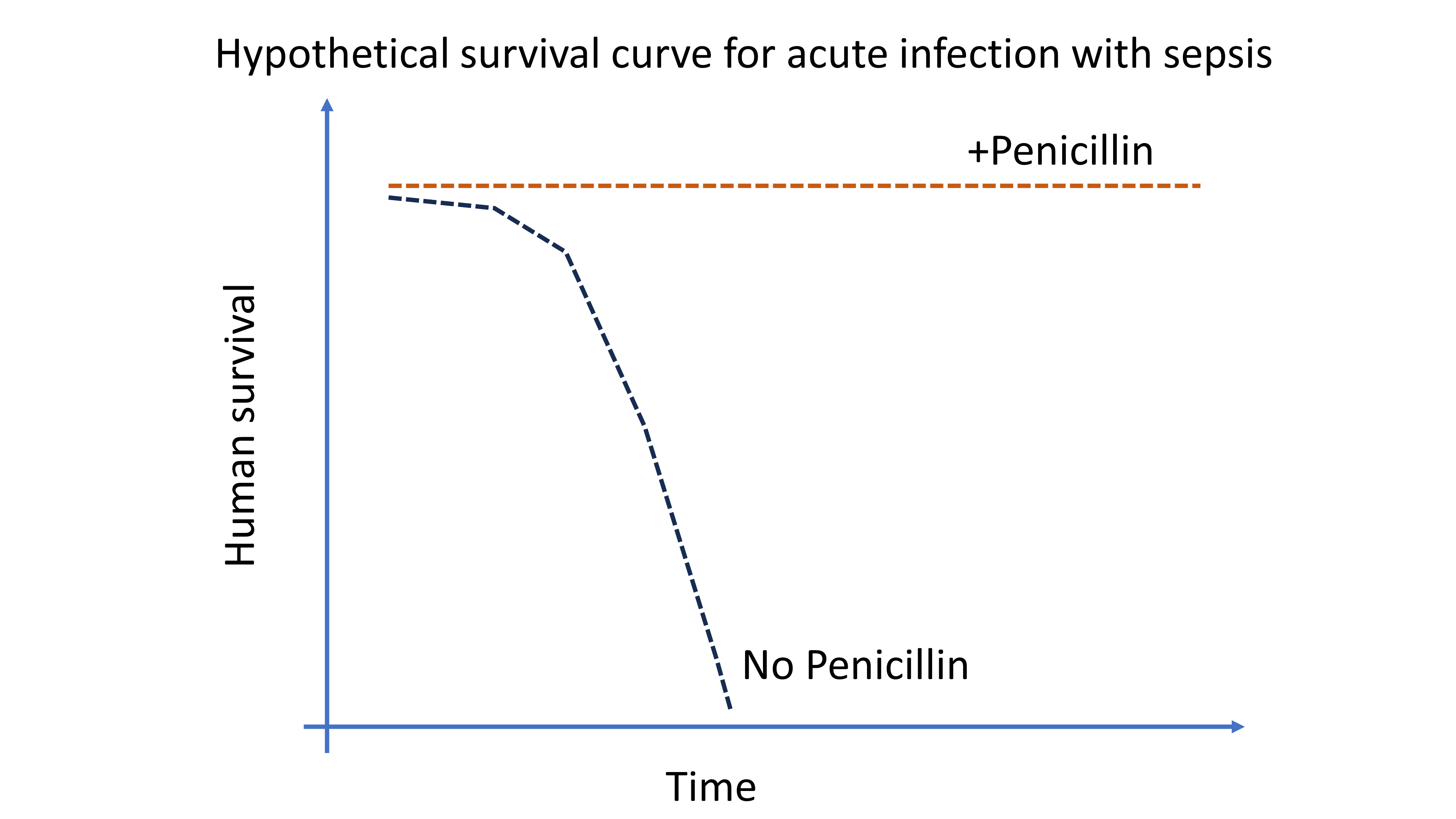
If a drug is useless, the KM curve looks like this: the treated group looks the same or worse than the untreated group.

Those are the extremes: works perfectly vs. doesn’t work at all.
In the referenced study in mice, the KM curve for NMN showed a modest benefit, the treated mice got a little boost. The mice receiving NMN did not achieve immortality or even double their lifespan. But it’s better than nothing. The average mouse lived maybe a month longer. That’s pretty significant. They only live about 3 years. If it scales up, and people get the same benefit, that might be like a person getting six more year of life. Of course, that’s the big question, right? Does it apply the same way in humans?
Here’s another KM curve, but this one was for calorie restriction in monkeys. Basically, scientists measure monkey lifespan when they are eating whatever they want compared to monkeys on a pretty strict diet. The low-calorie diet makes a difference!
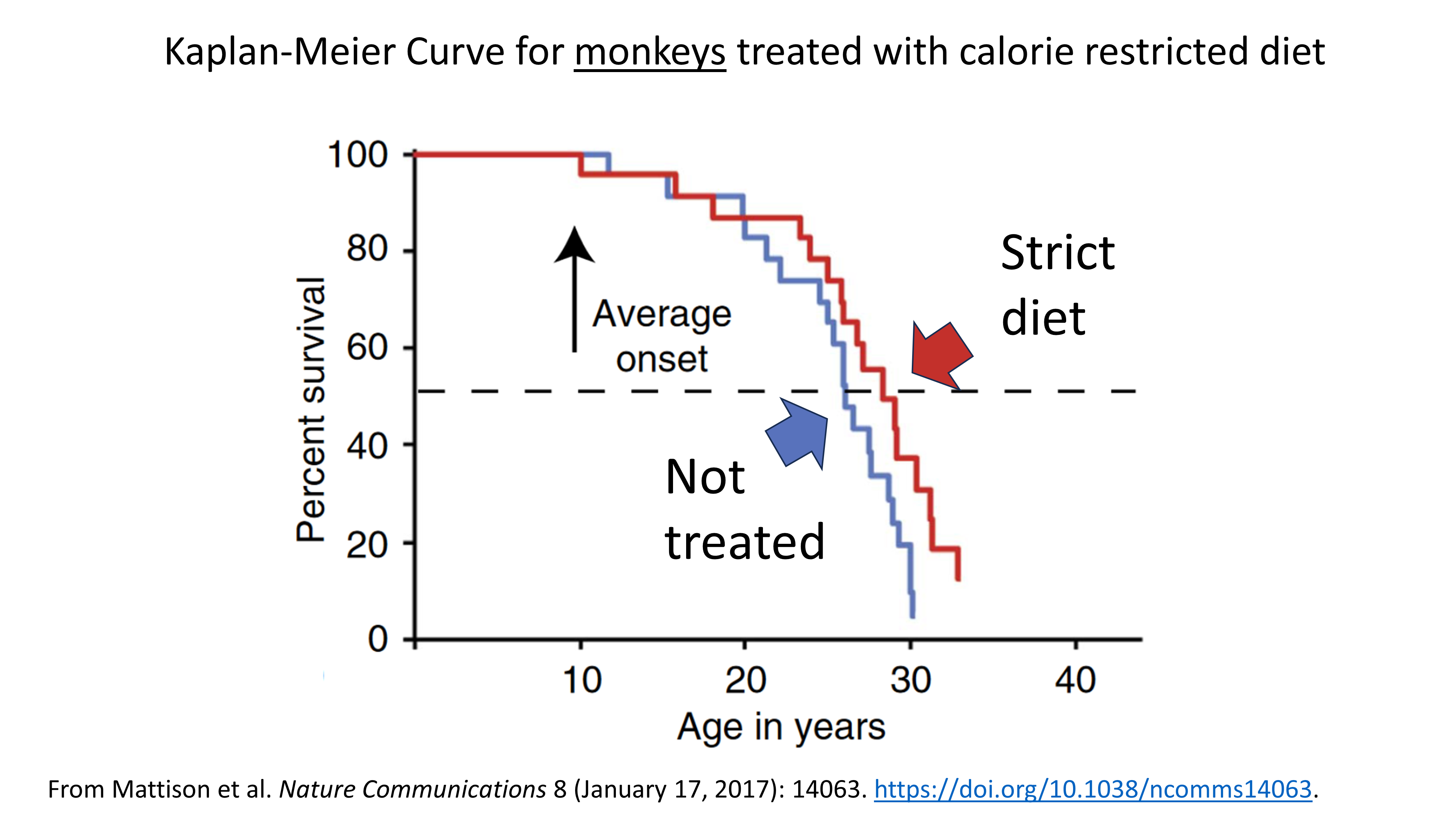
But look at how long it took to run that experiment. It took more than 30 years. It takes even longer to get results in humans. That’s what we want – a KM curve to show that NMN or NR extends life in people. But we won’t get that until 2040 (if ever), and I don’t want to wait. So, we’re going to have to do more science to ask if it’s LIKELY that NMN or NR will do the same thing in people that it does in mice.
The hypothesis is that NMN works by raising NAD+ levels up to youthful levels inside the cells.
Point 2: We think we know how NMN and NR work in mice, and we think they do the same in people
Enter NAD+ – one of the big molecular heroes in our body’s energy production. It’s like the spark plug of the cells’ combustion engine. It help to make the reactions happen when we burn up our calories. As we age, this spark plug fizzles out.
It’s easily as important as some other famous molecules you may have heard of, like vitamin C or ATP. NAD+ is part of how cells (mouse cells and human cells and basically most creatures) process food into energy. We build NAD+ out of NR or NMN – they are precursors for this important molecule.
That’s the theory behind NR and NMN supplements: they seem to replace those worn-down NAD+ spark plugs. So, it’s plausible that they might have a benefit in people, but we need more research to make sure.
Check out this paper. NMN and NR do raise NAD+ inside human cells. That’s promising! But it’s not just about whether these supplements increase NAD+ levels, but whether low NAD+ is, in fact, a key driver of aging. This is still unknown. It’s reasonable given that NAD+ levels go down with age. It’s also reasonable given that some longevity-related proteins called sirtuins need NAD+ to work. But we just don’t know for sure. At least we can say that (so far) the data indicate that NR and NMN are safe for human consumption (until proven otherwise).
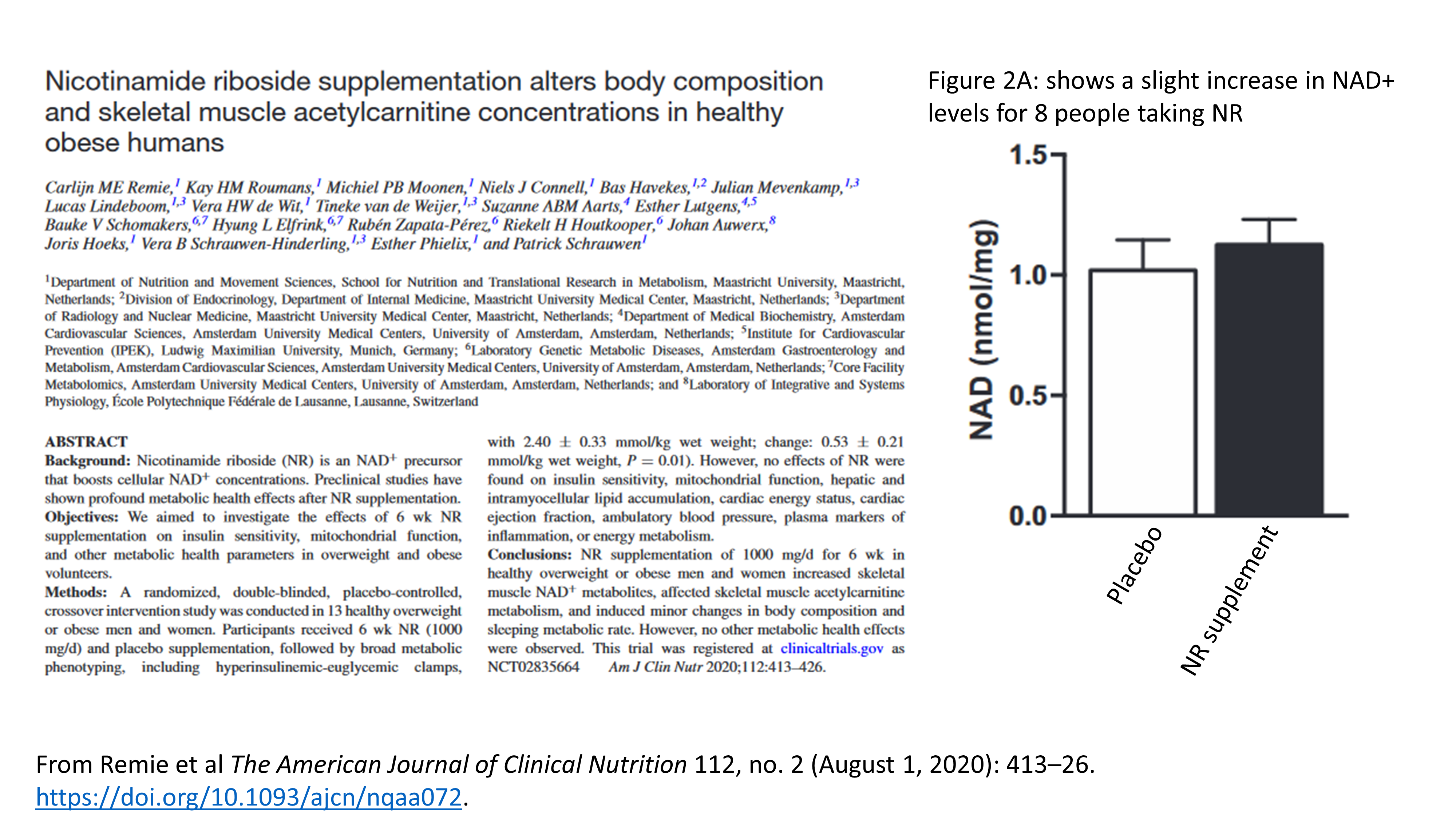
In the meantime, we will have to assess the risk, make an informed bet, and keep learning.
Point 3: Weighing the risk of NAD+ supplements
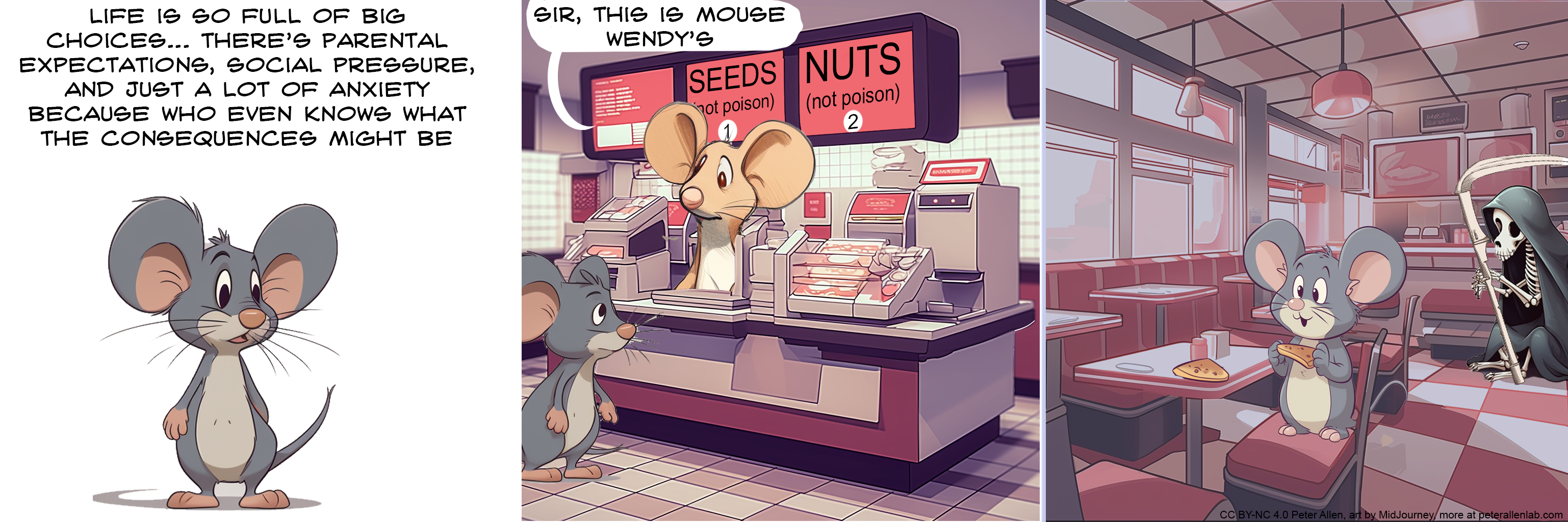
Life is all about risks and rewards, and these supplements are no exception. Door 1, you shell out for supplements, you definitely are out that money, and then possibly you gain a few extra healthy years, and maybe get dry mouth or upset stomach or other minor side effect. Door 2, you save the money, but risk missing out on the potential benefits of extra years of life. I choose Door 1, despite the uncertainties. Why? Because the benefits potentially outweigh the minor risks and costs.

The downsides are very small. NMN and NR are related to vitamin B3; they are generally recognized as safe by regulatory authorities. Side effects seem to be minimal in all of the studies I reviewed. Long-term effects of supplementation are still being studied. And there is always the risk of people having a rare response like an allergy or sensitivity. We make decisions despite not having perfect information. Our bodies are complex, and we are all different. But we face similar uncertainty in many aspects of life – all food, exercise and daily life comes with a little risk. All available evidence suggests that the risk here is small.
And that’s the subject of the comic at the top of the post.
Closing:
To sum it up, NR and NMN are intriguing guests at the longevity party. They might slow aging and buy us a few more golden years. The results from mice are promising, and these supplements are generally safe. But as always, talk to your doctor before adding any new supplement to your routine.
And remember that scientific knowledge is always expanding. NMN and NR are just the beginning. They are not designer drugs that we made specifically to fight aging. They are supplements that will have a subtle effect (if any). But there are exciting projects in the works. I hope that a longevity breakthrough is coming. As longevity science advances, I’ll keep posting here. And if something comes up suggesting that these substances are useless or even harmful, I’ll make an update.
So stay tuned for that – we’re all in this aging journey together. Nobody gets out alive.
References:
Remie, Carlijn M E, Kay H M Roumans, Michiel P B Moonen, Niels J Connell, Bas Havekes, Julian Mevenkamp, Lucas Lindeboom, et al. “Nicotinamide Riboside Supplementation Alters Body Composition and Skeletal Muscle Acetylcarnitine Concentrations in Healthy Obese Humans.” The American Journal of Clinical Nutrition 112, no. 2 (August 1, 2020): 413–26. https://doi.org/10.1093/ajcn/nqaa072.
Yoshino, Mihoko, Jun Yoshino, Brandon D. Kayser, Gary J. Patti, Michael P. Franczyk, Kathryn F. Mills, Miriam Sindelar, et al. “Nicotinamide Mononucleotide Increases Muscle Insulin Sensitivity in Prediabetic Women.” Science 372, no. 6547 (June 11, 2021): 1224–29. https://doi.org/10.1126/science.abe9985.
Zhang, Hongbo, Dongryeol Ryu, Yibo Wu, Karim Gariani, Xu Wang, Peiling Luan, Davide D’Amico, et al. “NAD+ Repletion Improves Mitochondrial and Stem Cell Function and Enhances Life Span in Mice.” Science 352, no. 6292 (June 17, 2016): 1436–43. https://doi.org/10.1126/science.aaf2693.
Note:
Comic art created by Peter Allen with Midjourney and Photoshop, licensed under CC BY NC 4.0 Creative Commons Attribution-NonCommercial 4.0 International (CC BY-NC 4.0) https://creativecommons.org/licenses/by-nc/4.0/
 Dr. Peter B Allen - Lab Blog