

Comics: First – Previous – Next – Last
You can also view this post in Video Format!
If we can kill off the senescent cells in our body, we will grow younger. This paper by Poblacka and associates describes a way to accomplish that… in cells in a dish. But it’s an important step and I’ll explain why. I want to go through a peer-reviewed paper I found really interesting. It’s about a new technique to kill senescent cells and it’s a step toward managing, slowing, or even stopping the aging process.
As we get older, we accumulate Senescent cells. Senescent is a word that literally means old, but in cell biology, it means a very specific thing: the cells are not dividing, they are not dying, and they are not doing their job. Senescent cells are part of the reason why we have health problems as we get old. They disrupt the immune system, they hog resources, and they are generally a bad thing to have hanging around.
A few years ago, a group of scientists engineered a strain of mice with “killable” senescent cells (see Baker et. al). They let some of these mice grow up normally, and they didn’t show anything unique, and they died like regular mice after about 3 years. But they took a group of these mice and used their modified genes to kill their senescent cells. These mice lived longer and looked and behaved healthier. It was as if they had aged in reverse for a while.
In human tissue, you can make the senescent cells turn blue. Senescent cells have an enzyme that most other cells don’t have called beta-galactosidase that can activate a blue dye. So, it might seem like making a drug that is activated by beta-galactosidase might be able to kill the senescent cells. But this enzyme is INSIDE cells and the enzyme is not totally unique. That poses two problems. First, the drug would have to get inside all cells in order for the enzyme to chew it up in just the senescent cells. Second, some other cells do express forms of Beta-galactosidase, and so they will be in trouble too.
What would be nice is a specific marker on the outside of cells that we could latch on to in order to drug those cells in particular. And this paper presents such a marker: it’s called B2M. If we can kill cells that are expressing B2M, then we can possibly de-age humans the same way we de-aged those genetically engineered mice.
B2M is on the cell surface. That’s really important. To make an analogy, B2M is like the Death Star’s Thermal Exhaust port. It’s a vulnerability right on the surface, right out in the open. Things flowing through the blood can get to it easily – it’s not hidden away inside the relatively protected interior of the cell. Now they need an X-wing, and that’s an antibody.
Antibodies are shaped more like a Y-wing, actually.
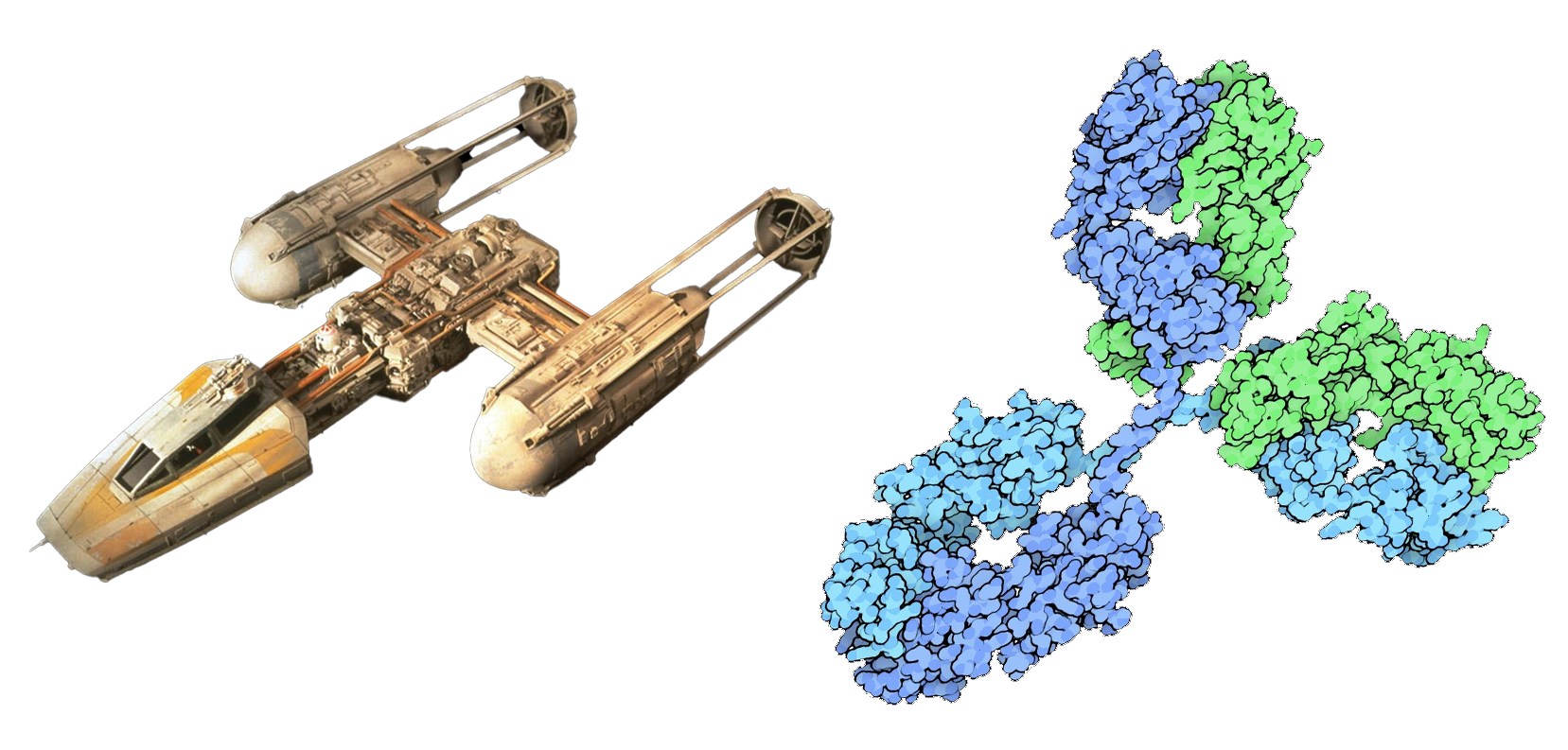
And these antibodies carry a powerful weapon. They attached the antibodies to a very toxic drug. That’s the proton torpedo. The idea is, if you can find the senescent cells’ vulnerability, you can use the antibody to target the drug right to the senescent cell and (even though the weapon is powerful) it will only kill the senescent cells.
The work by Polblocka et al takes this approach. They attached a drug to an antibody. The antibody binds the new biomarker, B2M, that is on the surface of senescent cells. The antibody carried the drug to the senescent cells and killed them. It’s a great targeted approach.
Antibody therapies are usually more expensive than traditional modern drugs, though. I’ve heard of several clinical trials for senolytic drugs that are trying to do the same thing as these antibodies. If those clinical trials don’t work out, then maybe the antibody drugs will work.
This is just the beginning of antibody-drug technology for killing senescent cells. This particular paper doesn’t even cover animal studies (much less human studies). So, we’re a long way from actual medicine. But there have been clinical trials on small molecule drugs that are trying to do the same thing. If those don’t work, this is an interesting alternative approach.
Further Reading
Poblocka et al. “Targeted Clearance of Senescent Cells Using an Antibody-Drug Conjugate against a Specific Membrane Marker.” Scientific Reports 11, no. 1 (October 13, 2021): 20358. https://doi.org/10.1038/s41598-021-99852-2
Baker, Darren J., Bennett G. Childs, Matej Durik, Melinde E. Wijers, Cynthia J. Sieben, Jian Zhong, Rachel A. Saltness, et al. “Naturally Occurring P16Ink4a-Positive Cells Shorten Healthy Lifespan.” Nature 530, no. 7589 (February 2016): 184–89. https://doi.org/10.1038/nature16932
 Dr. Peter B Allen - Lab Blog