
Comics: First – Previous – Next – Last
Why do I have to learn about DNA? Why is that required knowledge? I had a student – a graduate student, no less – ask me this, years ago. “Why do I have to learn THAT?” he said. Let’s talk about why learning about DNA (and science in general) is important. Let’s talk about Kevin.
This post is also a video! Check it out on YouTube.
[OP’s friend] Sage started dating Kevin about two years before this incident. Things seemed to be going all right between them.
Then, the talk of taking the relationship seriously came up — marriage, becoming a family, etc.
And that’s when the relationship began to die.
Kevin announced that he wanted to DNA test Sage’s kids to make sure they were his — the kids who were five and three when Sage and Kevin started dating.
He already knows those kids are not his… why would he want a DNA test? He has some pretty weird ideas about DNA. Let’s come back to Kevin.
JOBS
One reason for requiring something in the curriculum is because it will be necessary for a future job. But Kevin is never going to get a job working with DNA. He will be lucky to get a job that requires a food safety permit. But, not everyone is a Kevin.
There are jobs for people who know stuff. In this case there are jobs for people who know about the structure and function of DNA. There are doctors, geneticists, and bioengineers.
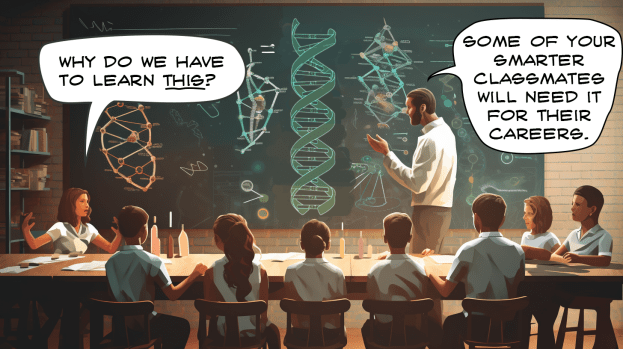
The comic is funny because Kevin in incurious. But let’s say you won’t need to know about DNA for your job. That doesn’t make you a Kevin. (Saturday Morning Breakfast Cereal did the original, better version of this comic. This is a little more specific.)
Should we “leave the DNA to the DNA people?” Should we leave science to the scientists?
CURIOSITY
What about curiosity? Curiosity is my favorite reason to learn science. I have always been curious about HOW things work. Science has the best answers for those questions. I earned my PhD in chemistry because I liked things that could be verified and tested. It is good to know how things work and it is worth understanding how people figured things out.
Our world is fascinating, DNA is a beautiful part of our world, and it’s a part we figured out, even though it was hard! There’s Jeff Goldbloom movie about it! It’s NEAT!
Here’s a question I found on Quora – a site where curious people ask curious questions (and sometimes try to get people to do their homework for them). This person was curious DNA and I approve.
“What is the difference between DNA and genes? Do souls carry DNA? Is this the same for both humans and animals alike?”
Here’s my answer:
DNA is a chemical, a physical molecule. It is a substance that can be extracted and measured like oil or sugar. In biology, the DNA molecule is used to store information about how to do “cell stuff.” Sometimes DNA is called the blueprint of the cell because it stores the instructions to build everything about the cell. DNA can also store the instructions that let cells build themselves into bigger things like trees and animals and people.
When humans study those instructions in the DNA, we call them “genes.” We know quite a bit about how the instructions in DNA work, and how biology uses them. For instance, some people have blue eyes, and some people have brown eyes. We know what parts of the DNA in people cause those traits. We might call those parts of human DNA the eye color genes.
Let’s make an analogy. DNA is like a physical book (a thing we can hold and weigh), genes are like the words that are written in the book (the information that is stored).
What is a soul? I don’t have a good answer for you. We have never found a physical thing that is a soul that we can hold or weigh. I think maybe the soul is like the mind – it is a property of the brain. Maybe it’s the patterns that the brain makes when we do people stuff. If that’s true, then the soul doesn’t have DNA, but humans and animals could have them.
One of the things that inspires my curiosity in science is the “how do we know that?” question. When I was a kid, I asked endless questions. I like to think I still ask endless questions. The great thing about science is that there is always an answer to the “how do we know that” question. It’s never “just because” or “because I said so.”
I don’t know the answer to the soul part of the question. Whether the soul is the source of our imagination or a figment of it, I’m pretty sure it does not have DNA. I’m pretty sure that for souls, “how do we know that?” comes down to “because I say so.”
But “what’s DNA?” or “what are genes?” Those are experimental questions. How do we know that DNA holds information? We could see from the microscope that cells have chromosomes. Scientists figured out that chromosomes have a lot to do with heredity. When chromosomes were isolated and purified and analyzed, they turned out to be made of DNA. Then scientists did experiments with DNA and they correlated specific DNA results with specific inherited outcomes. Then they got inspired and stored digital data on DNA, just to prove that they could. It’s all experiments, all the way down. I love that.
So, if someone asks, “why do I have to learn that?” I might respond “Aren’t you curious?” But maybe they aren’t. What if someone is not a very curious person? They do not have a fascination with experiments and evidence. The pure joy of knowledge is irrelevant.
CITIZENSHIP
How, then, should I respond to that question “Why do I have to learn that?” The answer from authority, is: “This information has been deemed important by educational experts who set it as a prerequisite for graduating. These experts set a standard for what should count as a minimally educated citizen in our shared modern world. Learning this is one step to meeting that standard.”
DNA (and other stuff like that, you know, facts about the world) might not be relevant on a day-to-day basis. But we want people to be prepared to function in a world where people do use this information. We want people to be good citizens who can function as a part of our democracy. Ignorant people cannot serve that function. They must trust more in people who do have knowledge. So even “because the state curriculum board says so” has something to do with our values as a society, like democracy and citizenship.
“Why do I have to learn this?” If we have to, we can resort to consumerism for an answer. It’s less important than citizenship, but people are also consumers. A DNA test is a thing you can buy. You should know what DNA is and what it does to be an informed consumer. Knowledge is useful to prevent scams or making foolish choices.
CONSUMERISM (or, SO YOU DON’T END UP LIKE KEVIN)
Do you want to be a Kevin? Here’s a story about Kevin.
Sage started dating Kevin about two years before this incident. Things seemed to be going all right between them. She told me he was a bit of a derp and sometimes incredibly oblivious to some things. He couldn’t pick up subtle cues, and even suggestions flew over his head with about a mile of airspace between his skull and the suggestion. She originally chalked it up to him being on the autism spectrum, as she has a few other friends who have similar problems picking up cues. So, she just switched her behavior from “talking to neurotypical” to “talking to neurodivergent”, and the bumps smoothed out for a while.
All was well and good.
Then, the talk of taking the relationship seriously came up — marriage, becoming a family, etc.
And that’s when the relationship began to die.
Kevin announced that he wanted to DNA test Sage’s kids to make sure they were his — the kids who were five and three when Sage and Kevin started dating.
Sage said she had to come to a full stop in the conversation for several seconds while her brain rebooted.
Sage: “They’re not your kids. You know they’re not. My ex-husband and I had them together before I ever met you.”
Kevin: “Yeah, and now that we’re getting married, they’ll become mine. I just want to DNA test them to be sure of it.”
Sage: “Let me see if I understand this. Do you… Do you actually think my children’s DNA will… change… to become biologically yours?”
Kevin: “Obviously. I just want the confirmation on paper, is all.”
There was a long conversation about how DNA didn’t work that way… He insisted that everything pointed to kids BECOMING “theirs.”
Kevin’s mom eventually had to become involved to back Sage up. His DAD had to become involved to back Sage up. A few books had to get involved to back Sage up.
Kevin was furious! … How could any kid who wanted to be adopted REFUSE to change one little thing so they could have parents?! “DNA doesn’t work that way” is a bulls*** excuse!
He ranted and raved, and right in front of his own parents, he told her that if her kids weren’t going to become his kids, then the marriage wasn’t going to happen.
He told her that he would give them all a week to change their minds and agree to be his biological kids. He said that WHEN they stopped being selfish, and WHEN the DNA test proved it, he would take the kids in.
The Original Reddit Post
Think about that for a second. He wanted a DNA test to prove that his (maybe) future step-kids had changed their DNA. He insisted that they should do that out of gratitude. One wonders if he thinks that he can alter his own DNA? Nobody can change their DNA! How did he get this crazy idea? Well, he was not going to accept reality if it contradicted his expectations!
This is the key to science denial. My preferences come first, reality comes second. It’s not just that he is a bad consumer, likely to get duped. It’s not just that he is incurious and that’s sad. It’s bad that he is like this because he is not equipped to be a good citizen. He is not equipped to help society make rational choices.
Do you have stories like this? Run across some like this on the internet? Not just science-illiterate, but confidently reality-contradictory? I hate it but I can’t look away. I’ve been reading “The War on Science” and “How to talk to a science denier” and this kind of thing is really fascinating to me. How can it be addressed?
If you have some juicy anti-science, drop me a link in the comments, or send me an email or voicemail! I’m putting a temporary address and phone number in the description and pinned comment. Get in touch! Maybe I can use your question/comment in a future video. I will leave you anonymous unless you request otherwise. Think of it as a hot tip line for “daily dose of internet” but it’s “daily dose of really bad science.”
Temporary email: comments@peterallenlab.com
Voicemail number: +1 512 487 7544
Links!
Saturday Morning Breakfast Cereal comic
The post from r/StoriesAboutKevin
 Dr. Peter B Allen - Lab Blog