Author Archives: Peter

Three meditation apps I like

I have tried three different meditation apps and found all of them have very good points. The first app I tried was called Headspace. It is well organized, habit-forming, and I like Andy Puddicombe’s voice (he’s the founder of Headspace and does all the guided meditations). He also did a TED talk which I suspect increased his visibility and gave his app a big boost. The only complaint I have about headspace is that it is very expensive. It costs $13 per month (though they have discounts for longer-term subscriptions). Their lifetime membership cost is $400. For me, it was worth it for one year to learn the skill, but not worth it for multiple years.

Brain.FM is a browser/mobile app that plays binaural beats while you work so that you can focus better. Binaural beats are an odd perceptual phenomenon. If you play two sounds that have almost the same frequency, the interference between the two waveforms makes what is called a beat frequency (beat frequency youtube demo). Here’s the weird thing: if you play one tone into your left ear, and a second tone into your right ear, you perceive the beat frequencies despite the waves not physically interfering with each other. Our brain reconstructs the beat frequency from the difference between the two tones. Supposedly, if that beat frequency matches certain brainwave frequencies, it can induce certain moods and mental states.

I don’t know if that is going to work for everyone. There seems to be some evidence that binaural beats do affect brain waves. It does seem to help me: there are different binaural beats for sleep, focus, and meditation. All of them seem to perform as advertised for me. The brain.FM app also has several guided meditations that I find useful. I got the lifetime subscription to brain.FM with a discount code; that offer seems to have expired, but there do seem to be other discounts available from time to time.

The third app I tried for meditation is Calm.com. The app can act as a background noise generator. It can make the sound of splashing water or wind through the trees (and several other pleasant sounds). I liked those when I was working in a shared office and needed some background noise to help me tune out distractions. They now offer several guided meditations and “sleep stories.” I’m excited to try sleep stories. I guess it’s like a meditative bedtime story to help you go to sleep. I usually don’t fall asleep well if I can hear talking or music. Still, I have found that a relaxation exercise before bed does help me sleep.

Bonus: I have also tried the insight timer which has a simple timer with chimes at regular intervals. It also has community-uploaded guided meditations. A few of those are good but most of them have a lot of ambient music that I don’t like very much (think sitars, zithers and didgeridoos).


https://www.headspace.com
https://www.brain.fm
https://www.calm.com

Bonus:
https://insighttimer.com/
Utopian communities sharing their experiences online

I get the impression that there are not all that many people interested in Utopia (as a concept). Maybe we’re a bit more skeptical than folks were in the 1800s. Or maybe charismatic leaders just don’t gain so much traction in an era with electronic criminal records and background checks.

The good parts of living with room mates were really good. A built in social network and a always-on source of good conversation and affirmation? Yeah. Doing other peoples’ dishes… not so much.

I follow three projects with utopian visions:

Open Source Ecology

Paul Wheaton’s Permaculture community

Focus Fusion

I love that these folks are putting their experiences out there. It’s exciting to see folks trying to build something grand. It’s even interesting to watch the setbacks. I don’t know how much popular interest there is in this kind of thing.


I have decided to argue with the flat earth society

For better or worse I have decided to argue with the flat earth society today. I almost hate to rehash the arguments against something so silly. But I want to use these arguments against the flat earth society as an example to make a different point.

Point #1against the flat Earth: the size of the conspiracy would have to be vast. Every NASA engineer, every phone engineer, every astronomer: they would all have to be involved in hiding the truth of the flat Earth if such a thing existed.

Point #2 against the flat Earth: If you go to the equator, you can see stars appear to rotate around both poles. It’s hard to resolve that without having a North and a South Pole. If the earth is flat, there can only be one pole right in the center.

Point #3 against the flat Earth: Someone in Texas sees the sun rising while someone in Korea sees it setting. A little triangulation would put the sun right beneath the surface of the Earth in Africa. That seems… problematic.

Having established these points, I want to back up.

Engaging the flat earth society by drawing their attention to these problems will be entirely ineffective. In fact, it might backfire. If I pointed these facts out to someone who held flat earth beliefs, they would almost certainly decide that I was part of the conspiracy. As such, nothing I said could possibly be trusted.

I think that the problem is that I am claiming authority. I claim to know the truth and I claim that they are wrong. I seem to be a part of the Establishment. I seem to be trying to force them to believe something. If they resent my position of “power,” they will tend to be hostile to my claims.

I suggest the following hypothesis. Educators will be more effective in dispelling false beliefs by pointing out a different form of authority with students from a young age. I suggest that the only real authorities are observation and reason. Maybe this can reduce that resentment-of-authority phenomenon.

Starting work at 4am is a mixed bag

Step 1: Wake up at 3AM

You remember your youth? Going to bed at 3AM after having a lot of fun? Maybe playing video games or drinking at a bar? It felt a little rebellious and irresponsible to be up that late (it’s almost early #LOL). Maybe if you had a late class or a flexible work schedule, you did these shenanigans on a weekday! Those were fun times. This is the exact opposite of that. Try to go to sleep at 7, but fail. Go to sleep at 9 instead and wake up barely able to function.

Step 2: Protein

Cereal over the age of thirty is a bad idea. Even bran cereal. That’s just sugar, and sugar wants to take up squatter’s residence on your belly. It’s harder to evict than your derelict former roommate, Martin, who ate your eggs, but doesn’t feel bad about it because they are not free range and factory farm cruelty excuses theft, apparently. Cook an egg for breakfast because you are a grownup.

Step 3: Coffee

Using a clean coffee maker, brew up 8 to 10 cups of Walmart’s Great Value Medium Roast. It’s a great value! There are no calories in a cup of black coffee but there are 100 milligrams of caffeine (It is by will alone I set my mind in motion). Drink a cup (or three!) to get you started and put the rest in an insulated container to nurse over the rest of the morning. Coffee kept hot on a hot plate will taste like death in less than an hour.

Step 4: Go to work

To start the day, read a nice think piece about your work. There’s no need to jump right in to the real work of the day. You’re in at 4AM. If you read for an hour to get your head on straight, you’re still ahead of the game. For God’s sake, don’t read the news. Not even as a joke. Block that on your own computer if you have to, like NetNanny for adults. Yes, there is an app for that.

Step 5: Panic at 6AM

Holy crap, have you  been at work for 2 hours? What have you accomplished? It’s the equivalent of 11 AM for anyone on a non-insane schedule. Have you written anything? A blog post, at least? Part of a paper? Code? What’s the point of getting up before dawn? You could have “slept in” until 6AM. That’s a statement that is absurd on its face. Maybe you should meditate or something.

Do you prefer your morning routine parodies in video form? Here you go:


Averages and niche markets in cancer and chickens

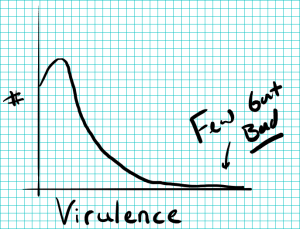
Averages can be misleading. In cancer, it’s the outliers that matter. The average virulence of the cancer cells is less important that the few cells that are really bad.

2017-03-15 06_06_08-Krita

Here’s an example of averages being misleading in terms of evolutionary success. If hens have very particular tastes, the rooster who appeals on average may not have as much success as the rooster who appeals to a niche. The high average is a generalist strategy. It’s OK for all the hens. That strategy can lose out to the specialists. If there are enough specialists, or if hens only make eggs with really attractive roosters, the generalist will not do as well.

2017-03-15 06_14_06-Krita

So, bottom line, it’s dangerous to rely too much on averages. It’s true in business, too. A product that appeals to everyone can get out-competed by all of the niche products in a crowded market. There are a lot of flavors of pasta sauce. The sum of Ragu’s different flavors out-sell the classic Prego by a fair margin.