Author Archives: Peter

Cool mini AFM has me thinking

A new paper in the IEEE MEMS Journal talks about a single chip atomic force microscope. Typical atomic force microscopes run anywhere from $10k to $200k. Atomic force microscopes are very expensive because they require complex alignment of an extremely small pointed object (like a little miniature stylus) to the thing you’re trying to take a picture of. They work by scanning that sharp tip across the object like someone reading braille. The result is that you get a picture of that object that is not limited by the wavelength of light (it’s hard to take pictures of things that are smaller than the light itself).

Anyway, if you can make an atomic force microscope on a single chip, you don’t have to align anything. It just is all built into the same precisely manufactured device. It might be perfect for looking at DNA nanotechnology. I wonder if it would be possible to integrate that with a optical microscope and maybe a laser trap. That would be really good for looking at cells. Or even microparticles like I like to make. It’s probably not going to be good enough to look at single organic molecules (as cool as that is).


Exploring Raman Spectroscopy for Beer

Raman spectroscopy has been used to analyze beer before. There’s even a undergraduate exercise that will let a student calculate the percent alcohol in a sample. I want to try it. It’s definitely not just an excuse to try a bunch of different beers.

Raman is like the complement of IR spectroscopy. People are familiar with IR spectroscopy because it is commonly used in organic chemistry classes. Raman is better for aqueous samples than IR (usually) so it makes sense to apply it to beer. This spectrum adapted from Zou et al shows why. The peaks for ethanol are nicely distinguishable above a low background from water. raman spec of waer and ethanol.png

There are nice hand-held Raman instruments that will give all kind of useful information about a unknown substance. It has been used for things like law enforcement (is that powdered sugar or freebased adrenal glands?) and Department of Defense business. So it’s natural to apply it to beer. It should be possible to amass a big database of beer spectra, annotate it, and mine it for useful information.

But what we need is a cheap instrument that beer enthusiasts can use to take spectra and contribute. A Beer-o-scope or Beercorder. I’m not sure about the name. But as fun as that sounds, I do need to make sure it will work. To the lab!

On not reinventing the wheel and using Biopython

The wheels of open-source,” is a plea to not keep reinventing the wheel. It resonated with me because I love reinventing wheels. I’ve been writing code since 1997. My favorite thing about writing code is implementing my own idea and seeing it work. It’s addictive. The fact is that someone else had that idea, implemented it first, then tested it and improved it. Using their code would have huge advantages, but I don’t get the same dopamine rush.

Logic and preference diverge.

I’ve been learning to use BioPython to analyze high throughput sequencing data. I’ve tried k-mer analysis based on an article from 2011, and that sort-of worked. I got an aptamer… but it didn’t bind native protein, only recombinant protein. And it was the most successful candidate that came out of the k-mer analysis.

2017-02-10-06_36_35-open-qpcr-paper-figures-outline-003-pptx-powerpoint

So: back to the bench, or back to bioinformatics?

Might as well try to get more from the data we have, I thought. The trouble was that… bioinformatics is hard. I could figure out how to do k-mer analysis by trial and error. How about phylogenetic trees? How about a scoring system for sequence similarity? These things have been done carefully and checked for statistical correctness and computational efficiency.

So… it’s time to not reinvent the wheel. It’s time to follow logic.

Experience with the open qPCR

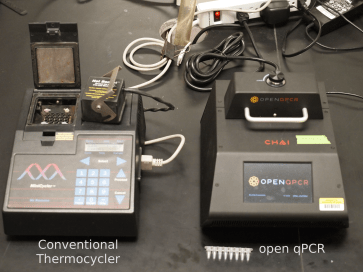
The Allen Lab acquired an open qPCR instrument about a year ago. We were on the waiting list for a year, but they delivered. It’s about the same size as a conventional thermocycler, but it does more. It has blue LED illumination inside the heated lid and a green light sensor below. The result is that you can track fluorescence as you thermocycle. The key patents on qPCR just expired so I think they are safe from major litigation.

P2091784.png

The instrument’s software is open and quite well designed. You connect to it with a USB cable and then use a browser to connect to its internal software. Once it is running, it doesn’t seem to need the PC connection.

It can do conventional real time PCR as well as melt curve analysis. I have been using EvaGreen dye but I suspect that it would work with SyBr Green or Syto9. I’ve read good things about syto9.

My application has been to use qPCR instead of cyclecourse PCR for my students’ aptamer selections. We also used it to verify the DNA on the surface of microparticles. We can go down to about 10,000 molecules (probably limited by cheap plasticware that adsorbs some DNA; lo-bind plastic might lower detection limits further).

I did have to do a hard reset once after a failed update, but for the most part it has been a reliable instrument.

Fake news, fake threats, and marketing

I avoid the news like the plague but I do like zombie stories. I’ve been thinking about why zombie stories are so popular in American culture. Cracked has some funny hypotheses (excitement, free stuff, simple choices, immediate promotion to head honcho). I think all of those are part of it. I also think that zombies are the perfect example of fake news style marketing.

Robert Anton Wilson warned us of how news could be used for marketing. He made up a conspiracy he called the fnords. In the Illuminatus! Trilogy, the word “fnord” is hidden in all sorts of text – news especially. We have been trained not to see the fnords. We ignore them at a basic psychological level so they are essentially invisible. But they make us feel scared and apprehensive. Everything you see and read has fnords hidden all over, especially the news. The only exception is advertising. Advertising is our one relief from the relentless attack. This encourages consumerism.

Zombies are the same thing. They represent all the fake threats that haven’t happened, but that we sense might happen. And these fake threats are really good marketing.

Yesterday, despite my best efforts, I ran into a “news” report about a new and worsening crisis at the Fukushia Diichi power plant. It was garbage. No, the reactor is not falling into the ocean. It’s as stable as ever. Yes, it is still dangerous to go in. Yes, it will be an expensive clean-up. Recent assessments indicate it might be even more expensive than earlier estimates.

So why make stuff up? Why put “Japan declare state of emergency as Fukushima reactor 2 falls into the ocean” as a caption on an image?

Ads. The original fake story has ads plastered all over. How to win the lottery! Photoshopped pics of Emma Watson! You won’t BELIEVE what happens next! Fast relief from all the anxiety we JUST CAUSED! Click! Click and Consume!