Author Archives: Peter

Rats of NIMH and personalized medicine

This morning I saw an animal scurry across the street on my way into work. I’m not sure if it was a very small cat or a very large rat (it was 4AM and still dark). It got me thinking about rats.

I remember reading in Rats that some pest control technicians thought that the older, experienced rats could read. I laughed about it at the time. But there was an article recently about pigeons that can read, so maybe it’s not too far-fetched. I mean, they are recognizing words, not interpreting language, but that could still be an important survival advantage. Being able to recognize “POISON,” for instance, could definitely be an advantage for a rat.

That makes me think of Mrs. Frisby and the Rats of NIMH and how different the book was from the animated movie. The book was more “realistic” and didn’t have the deus ex machina ending. Still, both had a bit of an anti-research subtext. People feel bad for the rats, but lab animals are still necessary.

Maybe not forever, though. There’s  Organ on a Chip technology coming that may make it possible to perform tests on human tissue instead of animals. That would have a lot of advantages. Animal experiments are not always relevant to people. A human organ-on-a-chip would have the biochemistry perfectly matched to human. It would also be easier to get huge amounts of rich, biochemical data from the system. It’s hard to continuously monitor a live animal.

Finally, I see huge potential for personalized medicine in the organ-on-a-chip. This is already happening in cancer treatment.
Conformation switching aptamer selection

I’ve been reading the literature on conformation switching Aptamers. The idea is to perform rounds of selection to find DNA molecules that change their shape or conformation when they bind a target. The main strategy seems to be to select by releasing DNA from a capture particle.

Morse, D. P. Direct Selection of RNA Beacon Aptamers. Biochem. Biophys. Res. Commun. 2007, 359 (1), 94–101 DOI: 10.1016/j.bbrc.2007.05.072.

Nutiu, R.; Li, Y. Structure-Switching Signaling Aptamers. J. Am. Chem. Soc. 2003, 125 (16), 4771–4778 DOI: 10.1021/ja028962o.

The fact that this works suggests something about the mechanism by which DNA Aptamers operate. One of the big questions that comes up in the lab is whether Aptamers are being folded around their target (an induced fit model) or whether they are switching back and forth between a folded and unfolded state even without the target (an equilibrium binding model). The fact that target can force Aptamers off of a capture particle suggests that the induced fit model may be appropriate in some cases.

On the other hand, a capture based selection strategy (Spiga et. al.) seems to fit either model. As long as the confirmation switches back and forth fast enough, an equilibrium model could account for partitioning between a capture particle and solution.

The downside to this strategy is that the particles need to have enough capacity to absorb all of the nonbinding DNA (which may be quite a lot of DNA at the beginning of the selection).

Spiga, F. M.; Maietta, P.; Guiducci, C. More DNA–Aptamers for Small Drugs: A Capture–SELEX Coupled with Surface Plasmon Resonance and High-Throughput Sequencing. ACS Comb. Sci. 2015, 17 (5), 326–333 DOI: 10.1021/acscombsci.5b00023.

Anyway, if you have a favorite conformation switching aptamer selection paper (and who doesn’t?!), maybe leave it in the comments or shoot me an email.

Open Source Software I use all the time

Open source projects I use all the time:

Whether for tutorials, editing images or manuscripts, there are open source projects that can help a scientist get a lot done for free. Not everything – I bought the Corel Videostudio software I use to edit the Vlog. I use Microsoft Office for various reasons. But when I can, I prefer to use an open alternative. Both because I am cheap and because I feel like it’s making the software ecosystem more open and accountable.

The paradigm of the PhD process

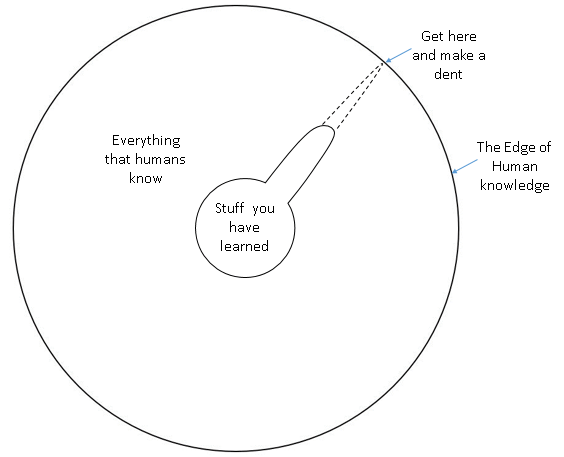
Matt Might writes some great material on his blog about what it means to earn a PhD and his experiences in academic science. I’ve learned a lot reading his posts and I recommend it highly. One of my favorite articles is “The illustrated guide to a Ph.D.” He talks about the Ph.D process and how that moves a student to the edge of human knowledge.

2017-01-17 09_00_28-what is a phd 2.pptx - PowerPoint.png

I was thinking about this in terms of paradigms. The typical student paradigm will get a person through a bachelors. I think it’s natural for students to approach their education as absorbing all the amazing knowledge that has been accumulated by humans.It’s like learning recipes that have been handed down for generations. These recipes work well, and learning them is very satisfying. They always produce good results.

The paradigm that gets a person to the edge of human knowledge is very different. As a student approaches the edge, everything gets less certain. The recipes stop working well. Sometimes they don’t work at all. It requires a lot of critical thinking to understand what recipes are applicable to your particular situation. It takes a lot of patience and failure to invent the right recipes.

But the paradigm of “learn the recipe, produce the result” will be deeply disheartening. That paradigm worked really well in the early years. At the edges of human knowledge, that paradigm will make the world feel hostile and cruel. It will feel like every paper is a trap with the key bits left out just to screw with the unwary student who tries to replicate the result.

The new paradigm is that everything is uncertain. Every uncertainty is an opportunity to bring experiment, observation, and ingenuity to bear. That is a hard and overwhelming perspective at first. Everything is uncertain? Yes. I think that’s a useful world-view for people to adopt.

Paradigm shifts in and ignorance

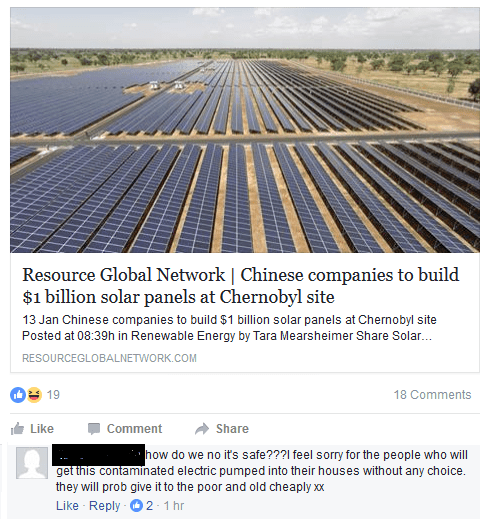
I’m thinking today about scientific paradigms. I saw a delightful example of scientific ignorance on the Reddit today.

ob9uv4lgas9y.png

A person was concerned that electricity derived from solar panels near Chernobyl might be radioactive. Electricity can’t be radioactive. The motion of electrons cannot carry charged particles or photons from one place to another. This Facebook post could be pure trolling. I don’t know. But I took it at face value at first and thought about how to disprove this hypothesis.

It would be easy to put a piece of copper wire into a radioactive substance and then put a detector at the other end of the copper wire and see if radioactivity was transmitted down the wire. It won’t be transmitted on the wire. It doesn’t work that way.

I have the impression that this experiment would be lost on someone who made this Facebook post. This Facebook post (again, assuming it’s not just a troll) is the product of a particular paradigm. I don’t think you can combat it with facts. I think you need to confront the paradigm. My guess is that the paradigm is an idea that “the government is hostile to poor people and old people.”

I don’t know that the Ukrainian government is particularly good or bad with regard to old and poor people. My point is not that the government is good. My point is that the assumption that the government is hostile and actively working against the interests of vulnerable people is what inspired this Facebook post.

Addressing this person’s ignorance about radioactivity would largely miss the point. If education has a role to play in helping this person have a better world view, then it needs to be both scientific and civic. It’s not enough to teach about how radiation works.