Category Archives: Uncategorized

Maybe scientific activism has confused people about the purpose of science

Scientific activism has had some amazing successes. Scientists have discovered a problem, lobbied for legal changes, and solved the problem. Example: there was an insecticide called DDT that bio-concentrated in birds. At low concentrations, DDT is not toxic to birds. But at high concentrations, DDT caused their egg shells to become very fragile and a great many birds died. Rachel Carson published a book called Silent Spring that exposed this phenomenon. Ultimately, this resulted in a ban on DDT. This allowed bird populations to recover. Another example is the chlorofluorocarbon (CFC) ban. In the upper atmosphere, CFCs degrade the ozone layer. A few scientists discovered this and lobbied to have CFCs replaced with less harmful chemicals. Once again, the ban was successful, ozone has started to recover.

When science discovers problems, we have become accustomed to scientists lobbying for the changes that they feel need to be made to address those problems. I’m not sure we should be totally comfortable with that. I understand that a scientist who discovers a terrible problem wants to help solve it. But I’m suggesting that scientists might be better off advocating for technological change rather than legal change.

For example, I’ve written here before that battery storage and solar electricity will probably replace coal. I don’t think that there is any need to ban coal. It will just happen because of economic necessity. Coal will get more expensive, solar electricity will get cheaper. As a scientist, I feel my time is better spent working on energy storage research as opposed to advocating a ban on carbon dioxide emissions.

We gave up DDT and chlorofluorocarbons in favor of other options that were less harmful. The chemists who invented the replacement chemicals are the unsung heroes of these environmental success stories.

Adenovirus-36 may be responsible for some of the obesity epidemic?

I put up a little video today about the adenovirus that causes obesity. I think it’s interesting topic. The Allen lab has been working on Aptamers against viruses since last year. So maybe I have something to contribute to that. Last time I went after an obesity related topic, my grant application was rejected because I’m not a clinician and I’m not working with one.

I would really love to find a clinician with whom I could work on this or similar. Example: I would love to develop a sensitive, point-of-care virus assay that would tell a clinician if a person was currently infected with adenovirus-36. Maybe then we could screen for a before and after case where someone was not obese until they caught the virus. Then we could point to the actual event and then show that that person got fat afterward. It would be a vindication of the hypothesis that the virus actually causes obesity and is not merely associated with it. We can’t deliberately infect people with the virus, but we could catch them during the infection. I could develop the assay, but I can’t work with the patients.

I like working back from big problems to the sorts of projects that we could do in the Allen lab. I make a little mind map in the video. I’m not confident that that’s the best way to actually get funding, though. I suspect that to get a grant, I need to work through human connections and collaborations. “Who is an expert with whom I can work?” may be a more effective question than “What is an interesting problem?”

Video:

Further reading:

Wired article

Physiological society article on the same topic

Gary Taubes’ Book: Why we get fat

The Onion article on a related topic


Acrylic microlfuidics, phase 2

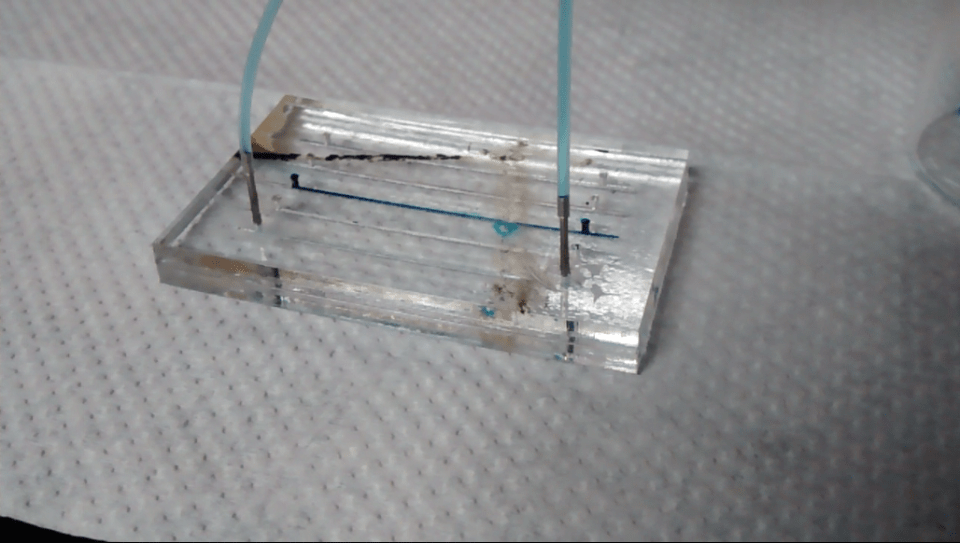
I designed a microfluidic based droplet generator based on a design from the Lee lab. After breaking my first one, I was able to get a chip secured to the scope. Nothing like spending an hour building something then dropping the keyboard on it. That’s fun.

img_1600

In any case, I cut the device on the laser cutter, assembled it and ran oil and water through it. I don’t know if we will be able to make the particles at the size I want, but we can make monodisperse droplets and that’s the first step.

2017-01-03-11_33_45-mvi_1603-avi-vlc-media-player

My goal is to combine this droplet generator with an in situ polymerization technique like this Langmuir article, “Semipermeable Elastic Microcapsules for Gas Capture and Sensing.”

If you want to see how it all came together, I made a little video.

Acrylic microlfuidics, phase 1

I would like to have a method for making a microfluidic chip in-house. In the end, I would like to make flow channels for rapid solution exchange around microscopic objects. I worked on something like this back in 2010 in the Chiu lab, but I don’t want to build up a photolithography setup (it’s rather expensive). I would also like to try to microfluidically generate droplets like Shim et. al. or even work from my colleagues in the Chiu lab.

How do you make microfluidics without lithography? I decided to try laser-cutting microchannels.

I used my laser cutter to etch channels in the surface of a piece of clear acrylic. Then I used the laser on a stronger setting to cut out a piece with the channels plus a second piece with through holes for access to the channels. I thermally bonded the two pieces of acrylic together. I used a cyanoacrylate gel glue (Loctite brand) to seal a 20 gauge blunt needle into those holes. I applied it around the needle barrel and then inserted the needle into the hole. I incubated the glue at ~30 °C for about 20 min to accelerate the cure. The result was a very good, liquid-tight seal.

2016-12-31 10_59_23-_hole size  fluid flow test 2.svg - Inkscape.png

I connected the device to a syringe pump with polyethylene tubing. The channel was able to carry flow up to the maximum flow rate of the syringe pump, 6 ml per min. The linear speed in the channel was on the order of .5 m/sec. I’m happy with that.

2017-01-02 05_18_12-VID_20170101_111838679.mp4 - VLC media player.png

That’s step one. Hopefully droplets will not prove too hard to generate. When I tried this some years ago, they were a huge pain.

Open Source Magnet Holder Stand

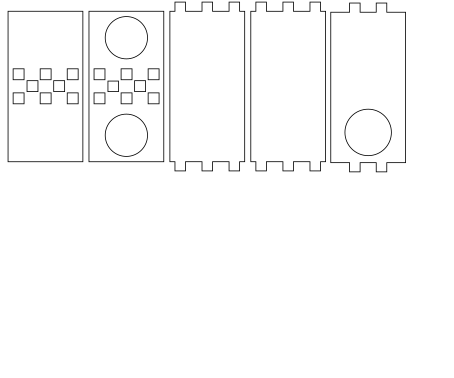
I built a magnet stand today. It’s comparable to a $100 Thermo Fisher product but only costs about $2 in materials. Maybe $10 if you have a service like ponoko cut the acrylic. The holes in the top hold a 1.5 ml centrifuge tube. The  center column has a receptacle for a 12 mm disc magnet. The design source file available in a github repository. I’m still learning github, but hopefully that makes it easily accessible.

The laser cut out these five pieces:

2016-12-30 12_05_32-OSSHmagnetholder_magnet holder stand 003.svg at master · drhex_OSSHmagnetholder.png

Then I assembled them into the stand and added a bit of superglue to the joints to hold it all together. It turns out that cyanoacrylate glue works really well on this material.

img_20161230_113956673

While assembling my fist prototype, the teeth were a little too big for the holes. One piece split apart and jabbed into my finger. It turns out that cyanoacrylate glues will also stop a cut from bleeding .

The use of cyanoacrylates to close wounds is nothing new. Cyanoacrylates are used in surgery and were used on the battlefield in the Vietnam war. I went searching for other blogs talking about this use of superglue and found this old Lifehacker article from 2012. So, yeah: you can close a wound with a little superglue. It’s not the best way, but it’s  it’s good to know in a pinch.

And now I need to digress a little.The top comment on this article is a pedant literally starting his comment with “uuummm, NO.” I read it in a nasal voice like droopy dog. It’s so stereotypical it’s funny.

2016-12-30 12_33_16-Use Super Glue to Quickly Seal Cuts and Blisters.png

Whatever, Droopy McProperface. Rub some dirt glue in it. There’s SCIENCE to be done.