Category Archives: Uncategorized

Laser cut optical filter adapter

I bought an overstock optical filter for the lab’s plate reader (Beckman DTX-880). I want to analyze Hoechst dye fluorescence (excitation 350 nm, emission 453 nm). My new filter is the right size for the excitation filter slider, but too small for the emission filter slider. That’s probably because the 450 nm – 480 nm is a  very common excitation size but not a common emission size.

2016-11-07-05_32_59-krita

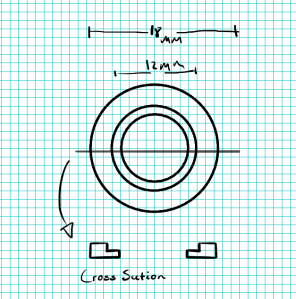
So, I need to either order another emission filter and custom size it to 18 mm diameter ($500) or I need to cut a little filter adapter ($free). I need something that will hold the 12 mm filter securely and block light. I envisioned something like this made from black plastic:
2016-11-07-05_37_50-krita

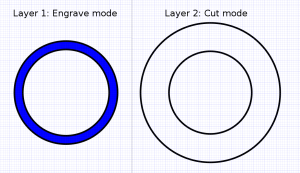
So I drew up 2 layers in Inkskape. The first layer made a partial engrave of a “rim” about 1mm into the 2mm thick plastic. The second layer cut the hole for the filter and then cut the part out of the plastic sheet:
2016-11-07-05_49_40-_filter-adapter-layerThe end result worked out pretty well. 2016-11-07-05_48_07-xnview-img_1590-jpgThe funny thing is that this laser cutter cost ~$300. So it has paid for itself already. Admittedly, it did take some troubleshooting… so maybe the cost benefit was not quite so clean. I had to replace the laser tube (which the company did supply) and I had to replace the power supply ($100). At this point I still call it a win.
Solar storage grid parity

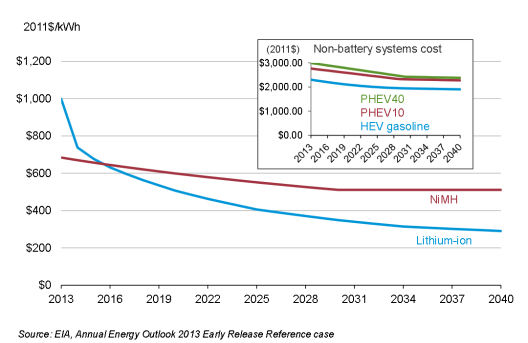
There are plenty of places where rooftop solar is at grid parity. We are approaching a time when stored solar electricity will be the cheapest power available even at night. Back in 2012, I estimated the battery price that would allow 24/7 solar to be as cheap as coal/nuclear electricity. I figured that stored solar would be in range of grid parity when batteries were ~$250 per kWh. In 2013, the EIA estimated that we would reach that price point in 2040.

2016-09-13 06_33_01-Annual Energy Outlook 2013 Early Release Reference Case - maples.pdf.png

The future is here early. Tesla and GM/LG are quoting prices from $140 to $190 per kWh. I suspect that if we tried to roll out a lot of grid-scale batteries, the additional demand would drive up the price (if only due to lithium supply problems). That being said, if you can do it with lithium, it’s doable with other chemistry. The constraints for stationary grid batteries are different than for vehicle batteries. Size and mass are less critical than price, for instance.

When long term energy scarcity is not a problem, I feel pretty optimistic about a lot of things.

Scrum for Science

I’ve started reading the Scrum: the Art of Doing Twice the Work in Half the Time. It has inspired me to attempt to use some agile development/Scrum principles in working on my lab’s current manuscript. I think it is working pretty well. We have the first figure and many of the first set of experiments. It’s a little bit tough to think about unpredictable changes in experiments designed to cope with the reality of experimental failure. Probably the most important aspects of the scrum cycle are its ability to cut down on procrastination and the flexibility it offers to a team of busy people with other obligations. My students are all involved in classes and have plenty of work without having to know lab. If they’re working together on a shared goals, they can make progress even though none of them have an extended chunk of time to spend dedicated to a particular experiment.

Let’s get down to brass tacks: how do we measure productivity and how good can we expect it to get?

In my experience, an ambitious but realistic goal in an analytical lab is to produce one paper per graduate student per year. If this method is as good as it claims, then we can produce four papers per graduate student per year. That would suggest that my lab should produce four papers this year and as many as eight papers next year (assuming that the Allen lab can get another grad student). Suddenly that seems wildly unrealistic. Is it? Certainly it would require some more editorial effort on the part of students.

I don’t know if it will ever get that good but I can already see that what would have been three very slow projects has become one very fast project using the approaches that this book has suggested.


Dragon Naturally Speaking for blogging, Gmail and Google Docs

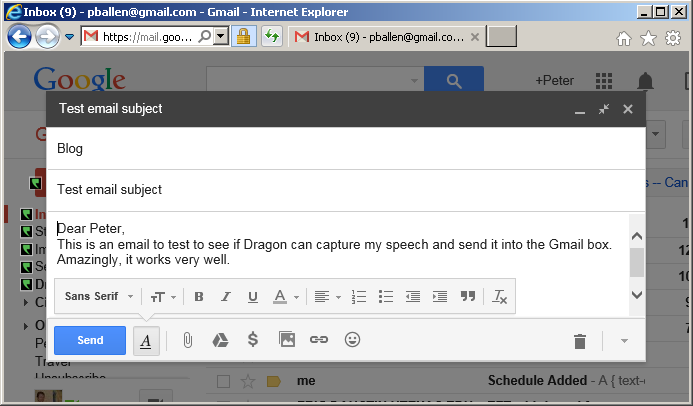
Dragon Naturally Speaking can capture speech into the Gmail text box. It works very well, but only in Internet Explorer. Chrome and Firefox used to always go through the Dragon Dictation Box, which is clunky. That seems to be getting better with later versions but IE is still behaves more how I expect.

One advantage of using the gmail compose box instead of wordpress for blogging is that I can insert images into the email body and then they publish seamlessly to WordPress. I like that a lot better than the wordpress insert image process (which doesn’t paste directly from the clipboard, alas).

I use a program called Greenshot to take pictures of things on my screen. It’s nice because you can drag-and-drop a particular section of your screen and copy it to the clipboard (there many other options for software that can do this). What this means is that you can arrange your screen the way you want, copy it, paste it into an email, and send that email as a blog post (like I did above). And you can do that all with Dragon integration to speed up the actual writing process.

Dragon works for google docs, too, though there are some bugs. You have to watch it pretty closely to be sure it does not introduce spaces and incorrect capitalization. In word, those things ‘just work’ for the most part.

FNANO 2014 Conference Day 4

I’m a little late due to travel, etc. But here’s the digelst from last Thursday’s final conference presentations.

Sjors Scheres showed the next step in DNA origami enhancement of cryo-EM imaging and tomography. Aleksei Aksimentiev talked about nanopore work.

Zorana Zeravcic was of particular interest to me because she was looking for rule-sets for computational self-assembly of particles. This basically is the theoretical framework for building larger scale structures from nano-powered micromachines. I have been thinking about how to program a microparticle in a “swarm” to act like a state machine, and I have some ideas. I have understood that such machines can be programmed since Eric Klavins’ class in graduate school. But this was another step that I have only a glimmer of an idea about: colloids in 3D creating self-replicating meta-patterns.

Andrew Phillips is from Microsoft. He talked about his meta-language for compiling DNA circuits from a higher level of abstraction. I think that’s great but I have not learned to use his software effectively. I need to learn it and I would love to find/create an index of the software ecosystem around DNA strand escange.

Alexander Deiters talked about his “side projects” in logic gates functioning in human cells. In particular, he made caged DNA that only does strand displacement after UV irradiation and could show that these SD reactions would occur in HEK cells after being transfected in directly. I think that surprised everyone, even him.

Zev Gartner showed some simply amazing work on using hydrophobic-modified oligonucleotides to label and assembly cells. He makes microtissues that display some amazing emergent behaviors that are not evidently seen in the cell types by themselves. One of the most striking examples was when he put few RAS mutant cells in with many non-mutant cells, he got hyper-motility. But in the reverse scenario there was not hyper motility. Something about the physical/chemical environlemnt of normal cells made the RAS mutant cell behave very interestingly.

2014-04-22 10_12_33-Programmed Cell-to-Cell Variability in Ras Activity Triggers Emergent Behaviors

Image from: Liu JS, Farlow JT, Paulson AK, Labarge MA, Gartner ZJ. Programmed Cell-to-Cell Variability in Ras Activity Triggers Emergent Behaviors during Mammary Epithelial Morphogenesis. Cell Reports. 2012 Nov 29;2(5):1461–70.