I’m digging into a a review of the Belousov–Zhabotinsky reaction in microfluidic doplets. Inside the droplets, various labs lab saw micro-oscillators as the BZ reaction proceeded. What was even more cool was that the reaction communicated among the droplets. As one droplet would react, it would affect the timing of the neighboring systems. I’m impressed with the variety of methods by which people have looked at tehis system. I wonder if my acrylic microfluidics will have some advantages for this kind of reaction?
People are anxious about the economy and health. I wanted to just assert that based on my own experience, but I looked up a report on the subject. The APA says that people are stressed about the economy and healthcare. Surprised? Not really.
There are things we (and by ‘we’ I mean America) could do to help with the economy and healthcare. We could automate more tasks and use that surplus labor for caring for sick people. But what’s the mechanism for paying for that? Should we tax the robots and use that money to pay for the things we want to do? That seems to make sense… kind-of.
(Actually no, not when you put it like that)
And yet… I find myself convinced that taxing the robots is not a great idea. An article on CNBC talks about why that would hurt the economy and reduce our competitiveness. If we don’t move to robots, we will just end up buying goods from the countries who do. Reason makes a good comparison between a robot tax and protectionism.
The bottom line is that we want to get rid of those jobs. People working in factories are not addressing better problems. There’s an opportunity cost. People working in factories could be taking care of old folks or taking care of kids. Or being creative. Or whatever. Every hour doing repetitive labor is an hour lost to mankind.
So what is the mechanism to pay for people to do good things (like nursing, teaching, learning and caring)? I suggest that we create the money. Currency should be created to match robotic production capacity and spent into existence on the issues we care about like health, education, and more robotics research.
P.S. This kind of thing is totally outside my circle of influence and I shouldn’t waste time on it. But… you know… anxiety.
I want to make microfluidics out of acrylic. Acrylic is stiff, resistant to a reasonably wide range of chemicals, and transparent. That means we can do chemistry in it and see what’s happening inside.
Acrylic is reasonably easy to cut with a laser. A $400 laser cutter can be purchased on ebay that will do the job. You get what you pay for, to some extent. It takes some effort to find an optimal cutting power and speed that give reproducible results.
Once acrylic is cut, it needs to be bonded. I have tried glue, double stick adhesive, and solvent welding. All bonded the acrylic but each has significant drawbacks. Glue and solvents both tend to wick into the channels. Solvents also tend to “craze” the surface and make it too opaque. Double stick adhesive tape introduces a new polymer to the system and is hard to handle. For larger features, we have had some success.
Ultimately, the best method to bond acrylic is to apply heat and pressure over some time. Heat should be 140-150 degrees C. That’s enough to soften but not melt the acrylic. Acrylic held in close contact for 10-15 min at this temperature will bond. Pressure should be few PSI (we’re working on measuring this precisely). Too much pressure and the channels will collapse. That is by far the most frequent cause of failure.
With the right parameters, a good bond can be obtained. A little superglue will bind a hollow needle into an access port. And voila: microfluidics. Now I need to use this to make droplets again.
I just ran across this paper “Alternative strategy for a safe rechargeable battery” in Energy Environ. Sci.. Like all new technologies, it may prove to have more problems than is apparent at first. That being said, this technology looks remarkable. It’s a battery chemistry that can use lithium or sodium metal. That is inherently a more energetic battery than a lithium-ion.
A lithium metal battery is likely to hold about 2-3 times more energy than a lithium-ion battery (all else being equal). So that alone will make battery operated cars competitive with gasoline. A sodium metal battery will be a little worse than a lithium metal battery, but better than a lithium-ion. But in terms of price, a sodium-based battery will win by a large margin.
Lithium is in short supply. A global transportation system based on lithium chemistry will take a huge amount of lithium. It will take big new discoveries to meet global demand if every car and truck is electrified. That is not the case for sodium. There’s lots of sodium.
So, if we want to transition to solar-storage for the grid, and battery-electric for transportation, it means we need a battery chemistry just like this: sodium, separator, carbon.
The key was the separator. Everything else seems cheap and relatively easy. The trouble is that most separators allow the sodium to form dendrites. Those dendrites act like little spears that punch through the separator itself. Once that happens, you get a short circuit and a fire. The U of Texas researchers made a sodium glass separator that prevents this. Here’s hoping this is the first the step to $0.10 per Wh capacity.
The work of science is the best teacher of science. Research is why universities are great places to teach and learn. That’s as good a reason as any to keep funding science. The economic benefits and the inherent challenge are good. But also the opportunities to learn are uniquely powerful. For people to learn cutting edge science, they have to be in it.
There’s this article on the Wall Street Journal (behind a paywall, of course) that talks about the work being the teacher. I very much agree. To produce good science requires a person to do the work. There’s no way to out-think it. Failure is a big part of that, too. Experiments start to fail when we are about to learn something.
I suspect that it’s true for lots of fields. Learning to draw, write, or anything creative means constant failure. But the only way to progress is to do the work.

 (Actually no, not when you put it like that)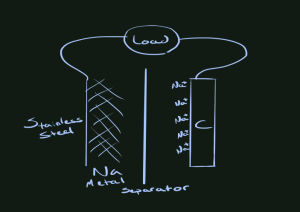
 Dr. Peter B Allen - Lab Blog
You must be logged in to post a comment.