New strategy for a safe, rechargeable sodium battery

I just ran across this paper “Alternative strategy for a safe rechargeable battery” in Energy Environ. Sci.. Like all new technologies, it may prove to have more problems than is apparent at first. That being said, this technology looks remarkable. It’s a battery chemistry that can use lithium or sodium metal. That is inherently a more energetic battery than a lithium-ion.

A lithium metal battery is likely to hold about 2-3 times more energy than a lithium-ion battery (all else being equal). So that alone will make battery operated cars competitive with gasoline. A sodium metal battery will be a little worse than a lithium metal battery, but better than a lithium-ion. But in terms of price, a sodium-based battery will win by a large margin.

Lithium is in short supply. A global transportation system based on lithium chemistry will take a huge amount of lithium. It will take big new discoveries to meet global demand if every car and truck is electrified. That is not the case for sodium. There’s lots of sodium.

So, if we want to transition to solar-storage for the grid, and battery-electric for transportation, it means we need a battery chemistry just like this: sodium, separator, carbon.
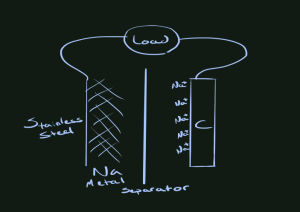
2017-03-06 09_31_12-Krita

The key was the separator. Everything else seems cheap and relatively easy. The trouble is that most separators allow the sodium to form dendrites. Those dendrites act like little spears that punch through the separator itself. Once that happens, you get a short circuit and a fire. The U of Texas researchers made a sodium glass separator that prevents this. Here’s hoping this is the first the step to $0.10 per Wh capacity.

The work will teach you

The work of science is the best teacher of science. Research is why universities are great places to teach and learn. That’s as good a reason as any to keep funding science. The economic benefits and the inherent challenge are good. But also the opportunities to learn are uniquely powerful. For people to learn cutting edge science, they have to be in it.

There’s this article on the Wall Street Journal (behind a paywall, of course) that talks about the work being the teacher. I very much agree. To produce good science requires a person to do the work. There’s no way to out-think it. Failure is a big part of that, too. Experiments start to fail when we are about to learn something.

I suspect that it’s true for lots of fields. Learning to draw, write, or anything creative means constant failure. But the only way to progress is to do the work.

Receiving scientific product email ads

I receive a fair amount of advertising for scientific products. I try really hard to keep my email box clear. I unsubscribe, block, and filter my incoming email with extreme prejudice. The sites I read for fun like medium.com and the folks I subscribe to on patreon.com are forbidden from emailing me.

The only email I am OK with is personal email from real people. So I was OK with an email campaign by duluth labs  where they actually sent me something that seemed like a real email directed at me personally. I don’t need their product, but I passed on the info.

Occasionally, spam hits the right person at the right time. Last night I was talking to a student about the pain and expense of setting up the lab for protein expression. The alternative is spending the money on catalog recombinant protein. Which is also expensive, but guarantees we get a certain amount of pure protein.

This morning I got a spam email from vectorbuilder offering custom plasmid prep services (the part of the protein expression process that I feel the least comfortable with). Any other day it would have gone straight in the spam folder… but today I clicked. I guess that’s the logic of spam: get a large enough list and you’ll hit someone at the right moment. As frustrating as that was, their site is pretty good. If it had clear pricing, it would be even better. Word on the web is that they charge ~$200 for a plasmid. Not bad, all things considered.

Laser cut acrylic microfluidics

I upgraded the laser focusing lens on my laser cutter to a shorter focus length. The K40 laser cutters to not have  an adjustable focus, so that’s a bit of a pain, but it does make for more narrow cuts.

I also got some 1 mm thick acrylic sheets from aliexpress. I would link better, but the source is gone. It seems that sellers come and go quickly on that site.

I can make very shallow cuts in the thin acrylic, but they collapse during bonding. If I make channels deep enough in the material to avoid this, I end up cutting all the way through.

So, back to the 2 mm thick acrylic. If I make a deep channel in the 2mm acrylic, I get great results. If I do a shallow cut in the thick acrylic it still survives the bonding. The same cut parameters that collapsed in the thin sheets work fine in the thick acrylic. Weird.

Bottom line, I’m back in the acrylic microfluidic business (so to speak).

p3011802-cr.png170301_summary.png

Maybe we can tax the robots? Maybe that’s not the best plan.

Bill Gates suggested that we can tax the robots to pay for a transition to a more service-based economy. It sounds to me like that might be a bad idea. The Economist talks about how taxing robots will probably slow the transition to a more automated future. That transition is a good thing and slowing it down is probably a bad idea. The Economist also notes that taxing robots does not address the problem of demand. If robots are capable of producing more than humans (and they are) then there needs to be some mechanism to create additional demand. Taxing the robot and redistributing that money doesn’t create enough demand by itself. At best, it only partially offsets the exploitative potential of a company that can produce goods without paying people.

Hackernoon takes the position that the money should be taxed from the people who own robots. It’s a more direct answer to the oblique reference in the economist. An automated company can exploit the market by charging people for something without paying workers. That company will generate obscene profits. Those profits go to the rich. So tax the rich, right?

I suggest that both of these solutions (tax the rich or tax the robots) amount to the same thing and are both counterproductive.  The more demand there is, the faster will automate. The faster we automate the better. The important question is not “who do we tax?” The question should be “what do we spend money on to effectively increase demand by the right amount?”