FNANO 2014 Conference Day 1

The morning session of FNANO consisted of a suite of presenters who discussed their photonics and self-assembly techniques. Ralf Jungmann talked about the DNA-PAINT technique which I find really remarkable. The idea is strange: transient interactions + fuzzy pictures + math = sharp pictures.

One can image a single molecule with fluorescence microscopy (this has been done for 20 years) but the details get lost. It just looks like a cloud and it doesn’t matter how good a microscope you use. It will always be a cloud. DNA-PAINT is designed to generate such clouds over and over. By carefully analyzing the series of transient fuzzy clouds, a computer can find their exact centers. By comparing the centers of all of the clouds (which overlap but appear at different times; I said it was weird) the computer can construct an image that is waaay below the limit of normal microscopes. I love it and want to try it.

Yan Liu and Philip Tinnefeld both talked about using carefully arranged metal structures to have a strong impact on how light interacts with matter. For instance, two metal nanospheres on either side of a fluorescent molecule make that molecule considerably brighter – like hooking it up to an antenna. Some thought was given to the relationship between humans new entry into engineering on the scale of light-waves, and how biology has been doing it for billions of years to accomplish photosynthesis. I think it will be hard to compete with nature in this arena, but I think it’s a wonderful enterprise.


In the afternoon session I got to hear mostly about non-biological self-assembly. One talk by Lee Cronin stood out. He makes nano-scale objects that are not made from DNA. That was an interesting change. Almost everything else has been DNA. His structures are not as designable in terms of shape and tend to be much more symmetrical. Still, his approach holds special appeal to me. He made a liquid handling robot out of a 3D printer that iterated hundreds of experimental self-assembly conditions in order to find an optimum. I did something similar a few years ago. I think that robotic approaches to the experimental work are a great way to do science without going crazy. Robots can generate a rich, reproducible dataset that can then be mined for interesting features.

Credit Cronin Group

Credit: Cronin Group


What can we really do about peak oil and global warming?

If you want to solve global warming, here is the method: help solar to beat the price per kilowatt-hour of natural gas. I think it can happen.

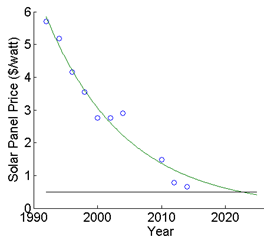
Consider the future of solar power. The price of panels is dropping quickly. A price of $0.50 per peak watt would have been absurdly optimistic a few years ago but it is now a virtual certainty. While solar panels may not advance as rapidly as Moore’s Law (as I read recently) they still fall in price by a significant margin every few years. I got my price data from renewableenergyworld.com. After removing the points from 2006-2008 because those years were hit hard by a silicon shortage, the data actually fit an exponential decay reasonably well.

 matlab_solar_energy_calcs

This graph shows the price of solar panels (blue circles) and an exponential fit to these data (green line). The black line indicates $0.50 per watt.

Continue reading

Conference on DNA Computing Liveblog Final notes

I hope my liveblog of DNA 19 was amusing. There were a lot of great talks. People seemed to think mine was interesting. I have to say that Peng Yin and the members of his group stole the show a bit. DNA bricks and the superresolution microscopy were really beautiful, plus he is involved in the RNAi applications (with Niles Pierce and others) which are very exciting. I think that was absolutely incredible. But the nanopore was probably my favorite structure (from the Simmel lab). All in all, I learned a lot and was very grateful to participate.

Conference on DNA Computing Liveblog 9

Kurt Gothelf showed how DNA can be used to assemble polymers. I usually think of polymerization reactions as being very random. I thought it was interesting that he can define a path across the surface of a DNA origami tile to make a directed polymer chain. The shape and structure are both controlled. These polymers also bind carbon nanotubes, so now you can put carbon nanotuves along defined paths? That sounds promising.

Tim Liedl talked about engineering metamaterials with DNA. Metamaterials have behavior that depends on their structure rather than their composition. Gold nanoparticles are very different than solid gold. They are arranging the gold/metal nanoparticles by using DNA. I lost the thread of the novelty of this material. I do remember when this group published a paper using gold nanoparticle-decorated DNA to control the chirality and optical activity of structures. They could make the little spiral gold structures rotate polarized light left or right depending on how they assembled it.

Continue reading

Conference on DNA Computing Liveblog 8

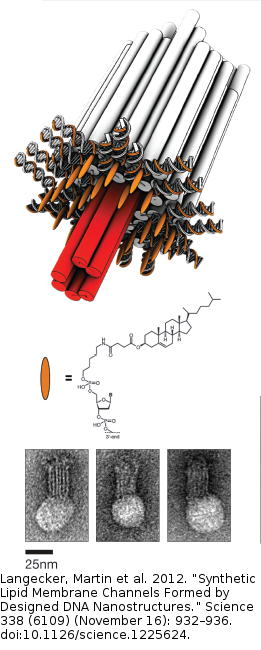
DNA_poreFriedrich Simmel showed recent work in functional nanochannels produced using hydrophobically-modified DNA. They are big and leaky but they work! They insert themselves into a membrane and make a big channel. Simmel also talked about hydrophobic folding of origami. That is really interesting from a protein folding perspective. It is not programmable like base-pairing, but it is orthogonal to base pairing and might be versatile in other contextx. They also made droplets and put a chemical reaction network oscillator inside. Evidently, sometimes, small droplets can oscillate but not larger ones. I would like to explore why that is in more detail. It certainly looks great.

Ned Seeman. Everyone in the field knows Ned Seeman’s contribution. The great vision was to use hexamer scaffolds extending in wide, repeating units to stabilize other crystals. He put the kibosh on that. It turns out that almost everything you might include in such a network destabilized it. But it did end up working and it did make some neat structures. Really, the Seeman group pioneered the structural DNA design idea. He also talked about Alex Rich in 1956 inventing hybridization, of which I had no prior knowledge.

John Spence talked about how X-ray lasers can be used for structural and dynamic biology. The system takes destructive snapshots and averages them (since each snapshot uses so much X-ray radiation that the molecules are destroyed in the process). Nonetheless, this can build up an average picture. If you do pulse-delay experiments, you can get a time-resolved movie of a molecular process. Very cool.