
ER-100 Clinical Trial Launched
There’s a new treatment clinical trial for glaucoma nerve damage and the technology is really cool and the implications big. It’s a little gross, and it will probably be misunderstood. It’s not stupid to be skeptical.
But those of us who want to share science with more people will have an uphill battle with this one. Even so, I think could be the Beginning of a new tech tree that will unlock whole new fields of medicine… if we can get past the panic.
I’m Dr. Peter Allen. I make videos about science and how science fits into society. You can follow me here or get transcripts and sources at peter allen lab dot com.
If you would like this essay in video form, it’s available on YouTube
How Cool This Trial Is
This is the official FDA approval of a clinical trial where a biotech company, Life Biosciences, has injected a dose of engineered viruses into peoples’ eyeballs. I’m here to convince you that this is a perfectly reasonable thing to do both for the benefit of those individuals and for the benefit of science.
This first of its kind therapy uses a heavily modified adeno-associated virus. The modified AAV is supposed to deposit an engineered DNA payload into eye cells. That engineered DNA payload convinces the cells to “partially reset” to a more flexible state.
Life Biosciences describes it as restoring youthful epigenetic patterns and function without converting all the way to a stem cell. The treatment causes three genes to be expressed: OCT4, SOX2, KLF4. That’s three of the four Yamanaka factors that cause cells to revert to pluripotency (they left out the fourth, c-MYC, for safety because it’s associated with cancer).
In animal models and in petri dish models, this partially reset state allows cells to regenerate lost tissue right where they already live. In other words, animals that had lost nerve function in their eyes regained it and were able to see again. So obviously, it’s very exciting to think that people who had gone blind from glaucoma might be able to take this treatment and see again. That’s a huge deal.
This is just a Phase 1 trial to see if it’s safe. But if it is proven safe (and it might not!), and if it proves to work (and it might not!), then it’s not just a big deal to the people who get to see again. Even more important than making blind people see, this technique of reverting cells to a more youthful state could be applied to lots of degenerative diseases, and lots of different injuries where people are not healing. Plus, it could be applicable to lots of diseases of aging.
I can tell you from some experience: I just don’t heal like I used to. Young people get an injury or have a surgery and expect to heal fully. An old person might never recover. Think broken bones. Think spinal cord injury. Think brain injury. Think heart muscle injury from a heart attack. Any of those might be approached with this new paradigm of reverting cells to a youthful state. In that state, the regenerative capacity and healing would be restored. This is a really big and exciting possibility.
This Trial Is Not As Scary As It Seems
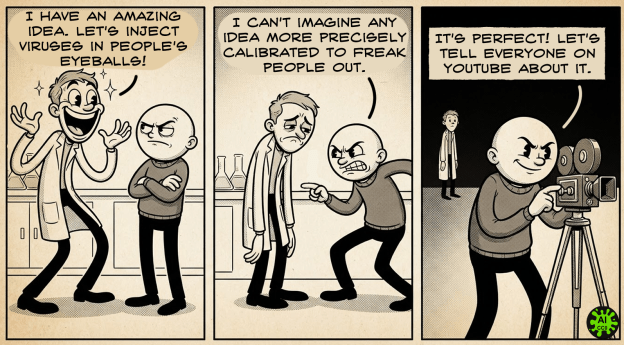
When I read this study, I see huge potential. This is the first clinical trial of its type. There will be more. This is just the beginning, and it’s the beginning of something really exciting. And I read about how they did it, and I wince. It’s uncomfortable to think about. When people on the internet hear this, they’re going to freak out.
I know it’s just too disturbing and disgusting to think about eyeball injections, much less an injection of viruses which seem like the physical embodiment of disease. It brings up a visceral, almost-moral reaction. So I know people are going to read about this, and if they get into the details, they’re going to pick that kernel of truth out and say, “Look! This is nefarious. This is mad science. This is villainous. Viruses are the bad guys!”
It’s not stupid to hear about this and be concerned. “Press x to doubt,” as the kids say. But these scientists are not just saying, “Let’s try sticking viruses inside people’s eyes.” It’s a very specific nano-engineered DNA delivery vehicle based on a virus, because viruses are very good at getting DNA into cells. It’s sort-of their main big thing.
There are layers and layers of safeguards. First of all, the virus they’re using is the adeno-associated virus, which by itself cannot replicate. It’s like a parasite virus that parasitizes other viruses. It only replicates in a cell that already has the adenovirus. If cells don’t have the adenovirus, this virus just delivers its DNA and then does nothing.
Secondly, they took that adeno-associated virus and they clipped all of its replicative machinery even further. So even if it were to infect a cell that has been co-infected with adenovirus, it couldn’t replicate.
Third, they’re using the eye as their environment of choice. The eye is a protected organ. The fluids are relatively isolated from the circulatory system. So even if something went wrong, it’s only going to affect eye tissue and not get out and affect the rest of the body.
Finally, they’ve engineered the genes that they are injecting into these cells to be activatable with a drug called doxycycline. So you give the drug to turn on those genes. If something goes wrong, you stop giving the drug. Genes turn off.
So there are layers and layers of safety.
All of these layers have been tested exhaustively in cells and in animals. As far as anyone could test, all of the mechanisms work the way they’re supposed to. They had to go through ethics review to test this in animals, institutional review boards and the FDA to get this approved for human trials. Lots and lots of checks had to be passed to make sure this was going to be as safe as it possibly could be.
There is reason to be concerned. One of the first patients to be treated with gene therapy using a viral vector, Jesse Gelsinger, tragically died during the clinical trial. In that case, it was an adenovirus not an adeno associated virus (big difference!) and the technology has come a long way in 27 years. In fact, the whole field took a big step back and proceeded with much more caution. Since then, the safety controls have been a great deal more strict.
And there are risks. The doxycycline switch may not work. This may increase cancer risk or push cells to lose their identity and disrupt tissues. But everyone who decided to try this treatment gave their informed consent. After Jesse Gelsinger, everyone involved takes informed consent very seriously.
There should be accountability. Scientists absolutely need to have safety checks: the institutional review boards, the ethics boards, and the FDA. There need to be people who can act as objective third parties and say, “I know you’re excited about all the good this can do, but you have to meet these requirements first.” That’s good and appropriate. It’s there. Nobody’s skipping steps.
But if we let visceral reactions and moral panic get in the way, exciting science won’t happen.
This May Be The Beginning of a New Tech Tree
People have talked about how science is slowing down, and this kind of advancement is the answer to speeding back up. The reason I think people are getting the impression that science is slowing down is because the old way of doing things (we find a target, use chemistry to hit that target, and then destroy some disease or some cell or some problematic mechanism) is running out of targets. Let’s take an example.
Pathogenic viruses have been generally fought with vaccines. In the last few decades, there have also been a few antiviral molecules — pills you could take that would help kill viruses in your body. The way that people developed those was they carefully understand every part of the virus. How does the virus replicate? How does the virus get into cells? How does the virus mutate? And when they have all that information, they say, “What part of the virus is absolutely required for it to function that can’t change very quickly in response to evolutionary pressure? And do we have any chemistry that can hit that part of the virus?”
Imagine there’s a giant robot, and you want to destroy it with a missile, but you don’t know where to hit it. Well, the first thing you do is get the plans for the robot. Then when you know what parts are vulnerable. Then you develop specific weapons to hit that specific vulnerable spot. If this was a videogame, maybe you need to advance up a technology tree before you can get those targeted missiles. That’s how whole classes of antiviral therapy were developed. These are big deals. And that general approach has borne lots of fruit from fighting bacteria to viruses to cancer. We’ve climbed that technology tree and we’ve come home with the goods.
But lost nerves in the retina can’t be treated that way. It’s a different kind of problem. There’s no vulnerable spot to attack on dead nerve cells. We need some very different approach. If you’ve climbed the technology tree for targeted missiles, it doesn’t help you build a bridge. So now we’re climbing this other tree, and that’s going to bear fruit too, but until it does, it’s going to feel like things are slowing down. If we don’t climb this technology tree then we will not achieve what is possible with regard to human health, regenerative medicine, longevity. If people say, “That’s terrible, don’t climb that tech tree, it’s scary. Viruses are bad, we don’t even want to understand them because they’re evil,” then people will die, because they won’t get treatments in time.
Overall, scientists have some of the highest trust scores globally. 56% trust scientists worldwide according to Ipsos, second only to medical doctors. 76% in the USA according to Pew. After the pandemic, there was a partisan split: conservatives lost some confidence in scientists. Despite the blame and attacks on the scientific enterprise in the last few years, science has mostly held on to public trust. The scientific community earns it through strict ethics requirements and rigorous oversight.
If we want to make progress, we are going to have to push back against the gut level reactions against “gross” science. That’s not license to skip steps or loosen oversight; quite the opposite. But there is work that needs to be done. There are still people who argue that gut reactions have intrinsic moral status.
>The wisdom of repugnance or appeal to disgust, also known informally as the yuck factor, is the belief that an intuitive (or “deep-seated”) negative response to some thing, idea, or practice should be interpreted as evidence for the intrinsically harmful or evil character of that thing. >From Wikipedia
This is intuitive and easy to sell. Here’s the pitch: “That thing you instinctively don’t like? Well, allow me to justify that instinct. Give me money or power and I will validate your fear and disgust.”
It’s an easy sell, but it is completely ridiculous. It is not wisdom at all; the Folly of Repugnance will only hold us back and empower scammers.
You know what’s pretty disgusting? An appendectomy. Imagine it from someone’s perspective who lacks medical context. Men in strange, dehumanizing clothes cut open someone’s belly. They root around with sharp steel tools in his innards and even remove some bits. It’s literal blood and guts. It is disturbing and even horrifying. It’s also a routine procedure that prevents a horrible and painful death.
The fact that this is gross is not evidence that it is bad. It’s not evidence at all. The clinical trial results don’t depend on whether we enjoy thinking about the procedure. They depend on outcomes: do people get sick? Is the treatment tolerated? Does their vision improve? Those are still open questions, but that’s what we need to test.
Thank you for turning in and i especially appreciate you staying all the way to the end. If you have exciting science and biotechnology that you would like me to cover or try to explain in plain language, please leave it in the comments And I’ll do my best to address it. Until then, stay safe out there.
Sources and Further Reading
https://www.technologyreview.com/2026/01/27/1131796/the-first-human-test-of-a-rejuvenation-method-will-begin-shortly/ https://web.archive.org/web/20260327001613/https://www.technologyreview.com/2026/01/27/1131796/the-first-human-test-of-a-rejuvenation-method-will-begin-shortly/
https://www.businessinsider.com/first-ever-reverse-aging-treatment-injected-into-a-human-2026-6

