Category Archives: Uncategorized

Copper in fat metabolism paper

Somehow I got linked to this paper (free on pubmed) on the role of copper in fat metabolism. I thought that the usual Science News Cycle or people who sell copper bracelets would be all over the results. I was pleased to see that most of the relevant news-y results on google were really cautious and not sensationalist. w

The study was an amazing piece of multidisciplinary science. It had:

  • Cell biology: inhibitor studies and biochemical pathway deductions
  • Biochemistry: analysis of proteins including expressing and analyzing mutant mutants
  • Synthetic organic: development of a fluorescent copper sensor molecule
  • Analytical chemistry: validation of the copper sensor with ICP-MS
  • Bio-analytical chemistry: fluorescence microscopy and image analysis of cells

That’s all in one paper. Seriously cool. And even though it’s all in mice and should be taken with a grain of salt, it is still worth thinking about micronutrients like copper and how to make sure they are in one’s diet.
Planned obsolescence as opposed to open source

We don’t buy our hardware, we rent it. All too often, our hardware is controlled by DRM-protected software that can be used to legally extort money from the “owner.”

Example: an inkjet printer can be programmed to turn itself off every 6 months and demand that the printer’s “owner” buy a fresh ink cartridge. The old ink cartridge may be physically viable, but the company wishes to get $50 per 6-month ownership period. Does this sound like a purchase or a rental agreement? It gets worse.

If you “buy” the printer, it may be illegal for you to change its software. Thus, you may own the plastic from which the printer is made but you are only granted a license for the software that is required to actually use it.

You “bought” the printer which was intentionally built broken and it is illegal for you to fix it. It would be more honest to say you signed up for a subscription or rental, but that is not what it said on the box.

Another example: the EFF argued in court that one should have the right to repair a tractor purchased from John Deere. The company argued that the “owner” of that tractor only had “an implied license for the life of the vehicle to operate the vehicle.” In other words, they owned the metal from which the tractor was made, but not the software required for it to run. Familiar?

These are extractive not productive economic decisions and they should be illegal.

Until they are illegal, I would like to suggest that people invest in backup hardware for critical tasks. Apple, Google, Microsoft and Amazon devices are subject to the whims of their respective corporations. We are encouraged to forget this fact. Everything about these devices is made to encourage us to think of them as ours but the truth is that these companies can brick the devices at any time.

I think it’s a good idea to maintain a Linux box (even if it is a beaglebone or raspberry pi) and local backup hard drive.

Some acrylic microfluidic results

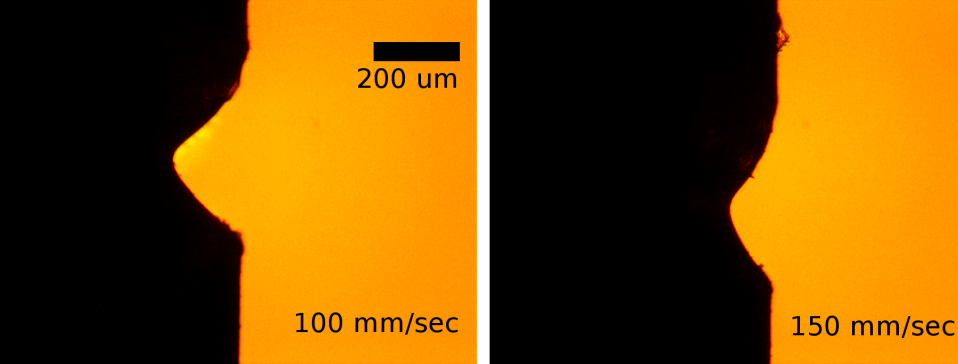
With the help of a talented undergraduate, there has been progress on acrylic microfluidics. I checked the depth of the etch as I changed the speed of the cut. The faster I translated the laser spot, the shallower the cut (as expected).

170131_summary.png

What was very encouraging was the fact that the acrylic sealed at all the depths; none of the chips collapsed and clogged. That means I can probably make channels as shallow as 50 microns and as narrow as 100 microns without much optimization.

I’m still hopeful that I might be able to get down to the 10-20 um range with some optimization, but that might require a new lens to focus the laser more tightly. Thankfully, those cost about $20 shipped directly from China. We’ll see how that goes in 2-3 weeks.

It’s a travel day, so my update schedule is going to be strange.

Batteries may increase a home’s grid demand. Weird.

There’s an interesting article out of U of Texas in Nature Energy this month (see also Eurekalert). It shows how adding energy storage could (counter intuitively) increase dependence on the grid. They model a number of reasons for this.

First, when you add batteries and keep the solar panels constant, you decrease the total energy production due to battery inefficiency (less energy out than you put in).  That has to be made up by the grid. But it gets worse if you keep the cost equal. If you sacrifice buying panels to buy batteries, you increase grid dependence.

So unless you have so much surplus energy you can’t sell it all to the grid, you are almost certainly better off adding more panels rather than batteries. That said, the utility may have excess energy during peak renewable generating hours and it makes sense at that point to buy storage.

Here’s a more verbal demonstration:

Returning to Headspace on Anxiety

I’m getting a bit overwhelmed. When I felt this way last year, I turned to Headspace on anxiety. Headspace is a website/app designed to help people meditate. The first series that you work through in Headspace are a gentle introduction to meditation in general. After that, there are specific sets of guided meditations for different issues.

I tried Headspace on Focus a while ago and I found that it really increased my anxiety. That helped me pay attention to anxiety as a contributing issue to procrastination. Now I am really feeling it again and I paid my $15 to get back into the anxiety program for a month. The yearly subscriptions are a better deal, but I feel like once I get into the habit again, I won’t need the guided meditation.

Here is Andy Puddicombe, Co-founder of Headspace, talking about anxiety. He explains that anxiety is just another kind of thought pattern. Anxiety is unpleasant; the impulse to stop it is natural, too. But coming to a bit of peace with it makes a big difference.