Acrylic microfluidics part 7

One of the reasons I am trying to develop these techniques for acrylic microfluidics is to shorten the design-build-test feedback loop. With the PDMS techniques I worked on and grad school the loop is about a week long. It takes a day to design, a few days to get the photomask, and a day or two to fabricate. If nothing goes wrong, I use to be able to get a design tested on day five.

With acrylic based microfluidics, the loop is much shorter. I can modify a design, cut it with the laser, fabricate the chip, and have it tested all within three hours. Three hours is a significant improvement over five days.

2017-03-28 07_43_58-Krita

This morning I came in and cut a new chip with some new parameters. I was hoping to see a narrower width channel which would produce smaller droplets. I didn’t get that, but I can try again (tomorrow not next week). Plus, I learned something. I need to add a viewing area to the chip to see the droplets better.

I made a little video of some of the process. I skipped the bonding step in the video because it’s just 10 minutes of waiting while the hot press does its work.
Here are parts 1 2 3 4, 5 and 6.

Droplet microfluidics with acrylic part 6

I’m just going to do a brief update today on the microfluidics project. We set out to make acrylic plastic microfluidic chips that could generate tiny droplets of water in oil. Eventually, I hope to use these droplets to make polymer particles. We can make polymer particles from a water in oil emulsion. We usually just shake the mixture vigorously to make the emulsion. But that makes all kinds of different sizes and causes other problems as well. So now we’re going to use a much more complicated method: microfluidics.

I have some experience with droplet based microfluidics. I worked on it in graduate school. It’s a simple idea. Flow oil and water through tiny tubes that merge into a single tube. This forces them to mix and they break up into little droplets. In practice, it can be pretty hard. One of the practical challenges is that it takes a stable flow rate to make homogeneous droplets. It can be a big challenge to get a stable flow. That’s especially true if your microfluidic chip is made of a stretchy material (I’m looking at you PDMS). It makes sense to move to a chip that doesn’t stretch at all like acrylic plastic.

I had a great undergraduate come in and work with me this weekend on creating droplets with an acrylic plastic microfluidic chip. I had this working a few months ago but with much bigger channels. My first success was with channels that were more like 1 mm wide. The droplets were close to 1 mm wide as well.

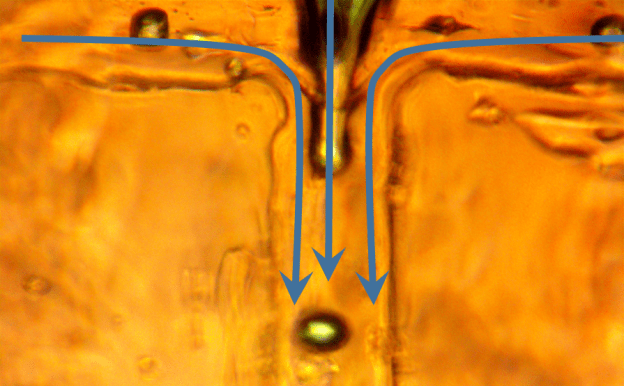
We set about to optimize a fabrication technique that would make smaller channels and then uses channels to make droplets. After much difficulty, we have succeeded. We are now making channels that are approximately 100 µm wide and making droplets that are approximately 50 µm wide.

2017-03-27 06_35_38-Presentation1 - PowerPoint

If you have an application that requires non-stretching microfluidic channels, please get in touch. We can send you one.

Here are parts 1 2 3 4, and 5.

Getting Things Done, Remember the Milk, and First Things First

I regularly use an app called Remember the Milk. Remember the Milk is a to-do list that syncs across my computer and smart phone. It has multiple lists so that I can categorize things a little bit. It has priorities so that I can sort things according to near-term and far term. It does due dates. It does notes. It saves URLs. It’s a pretty comprehensive little app.

Remember the Milk is my “bucket” for the Getting Things Done method. David Allen suggested in Getting Things Done  that he needed to have some trusted, central location to put to-do items. By having such a trusted place to put all his to-do’s, he could put them out of his mind and focus on doing something. Trying to keep track of all the things he was afraid of forgetting in his head made him almost crazy. He calls this trusted to-do list his “bucket.”

I try to do the same. When I’m reading email or working on a project, I look for to-do’s. Even cleaning the house brings up to-do’s (like buying soap or ordering vacuum bags). Trying to hold those in my head would drive me crazy. My head is full. Instead, they all go in the app. If I have an idea for a blog, it goes in the app. If I remember that I need to change the oil in the car, it goes in the app. Then they get sorted out later.

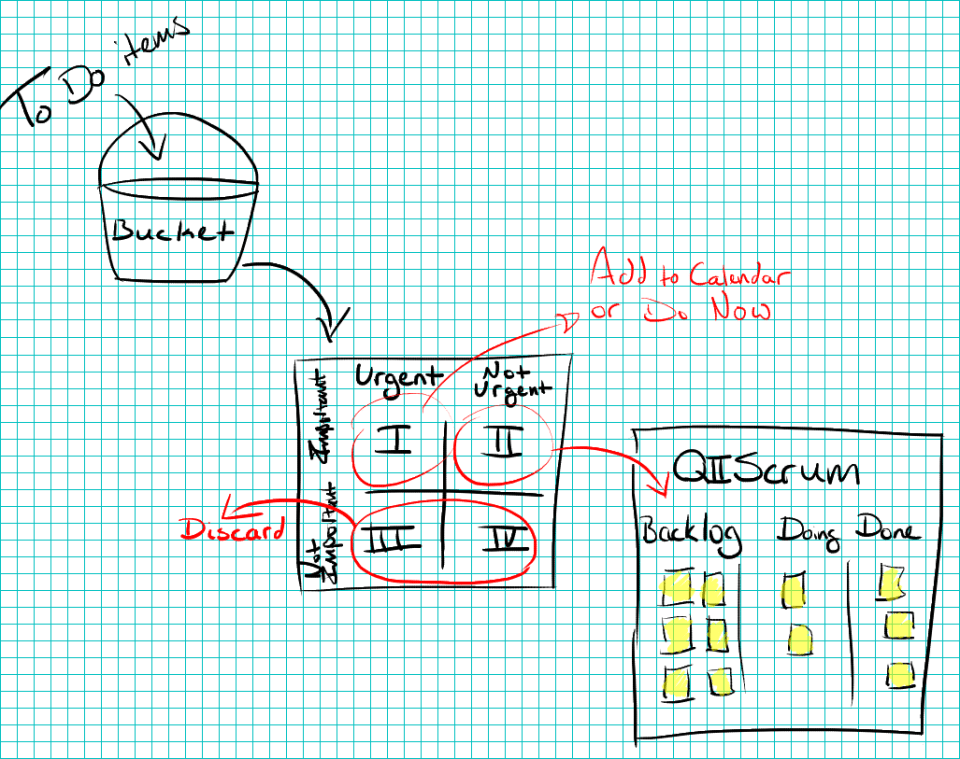
How do I sort them? I find that Covey’s First Things First method is most appropriate for me. He divides things according to importance and urgency. Things that are important-and-urgent are Quadrant I. Things that are important-but-not-urgent are Quadrant II. The non-important are divided into Quadrants III and IV accordingly.

2016-11-16 05_39_59-Krita.png

Everything goes in the bucket. The bucket get sorted into the quadrants. The to-do’s get done immediately, go on the calendar (if there’s a due date) or go on the scrum board (if they are Q2 – important but have no due date). Some things get thrown away. The shorter the list, the happier I am.

The difference between utopia and dystopia is doing the dishes

I believe in public funding for science and especially revolutionary, high-risk/high-reward projects.  Most of those projects will fail. That scares the funding agencies. It looks like a lot of wasted money. But I think that’s the price for innovation.

2017-03-23 07_07_42-Krita

We need to fill the beginning of the pipeline with lots of good ideas. When something works, there will be plenty of motivation to move it down the pipe. There are big rewards at the end of the pipe. I think that’s great. I just want there to be more support at the beginning.

For projects that do have support (and not necessarily government support), I also see the little human weaknesses as a real problem holding back important projects. The two projects that come to mind are Open Source Ecology and Paul Wheaton’s Permaculture community.

This article (brilliantly titled The Post-Apocalypse Survival Machine Nerd Farm) reminded me of what it was like to live with roommates. Not everyone is equally motivated. Not everyone wants to volunteer their hours getting up early to build a DIY tractor. And not everyone knows that about themselves. It sounds amazing: sustainable agriculture, technical puzzles, building great things, sharing new technology with the world… Utopia! But the reality is pooping in a bucket and getting up at 6AM to troubleshoot a burst hydraulic line.

The Permies community ran into a similar issue. The Wheaton Labs Farm invited a bunch of people to come out and live and plant and experiment with sustainable agriculture. But people didn’t want to do dishes or do the hand towel laundry. A lot of the unsustainable parts of our culture are a direct result of our coping with these little irresponsible things. Why use paper plates and paper towels? Because nobody wants to take care of the dishes and laundry.

The bottom line is that there are natural resources and technology… but getting people to cooperate and do the unpleasant work is the hard part. That’s no surprise, I suppose. It’s just funny that the difference between utopia and dystopia… at the micro level… is  doing the dishes.


Overwhelm leads to procrastination? WHY, brain?!

So why is it that feeling overwhelmed leads to procrastination? That’s like feeling hungry preventing me from eating. It must be one of the most strange and illogical impulses. Do you have too much to do? Better clean your desk.

I blocked distraction sites from my work browser (I use leechblock). That didn’t help, strangely. Other tricks:

Brain.fm – focus

Pomodoro – Set a timer for 25 min sprints + 5 min breaks

Amazon prime comes with music – try Liquid Mind or Mozart for Meditation

Coffee. Lots of coffee.