People argue about the mRNA vaccines. Are they safe and effective? And if people get it wrong, should we bother trying to convince them? This has become a contentious (and political) issue. I’m Dr. Peter Allen. I earned a PhD in bioanalytical chemistry. I am not employed by any company with an interest in vaccines, and this video represents my personal thoughts and opinions. I want to share some 2026 research on the vaccine safety. Thankfully we don’t need a lot of expertise to understand the broad strokes of this recent study. I want to examine what it means to the anti-vax position.
Frankly, this is the kind of research that is so clear, so understandable, that it should settle the arguments. This is how an evidence-based argument is supposed to work.
Aluminum is wealth. That sounds strange – it’s cheap, and it’s a recent invention. But the fact that we can all get use (goods and services) because of things made of aluminum is a kind of wealth. And it’s an example of a bigger principle. When someone tells you something is rare or scarce and equates that to value, remember this. Value comes from enabling more people to enjoy something, not from preserving its exclusivity.
We sometimes think (in our age of progress) that if we look back, we must see very primitive creatures.
But even if we go back ten thousand years, we don’t find primitive humans. We find modern humans. Genetically, we have not changed very much in 10,000 years. What has changed? We have learned a huge amount of chemistry, biology, etc. Of course we didn’t know which bits were useful. It took a hundred years to figure out. That’s how science works.
The discoveries of past centuries created some rapid changes. Example of progress: within a few hundred years we went from knowing what gunpowder was, to seizing guano Islands, to synthesizing ammonium nitrate to nuclear weapons.
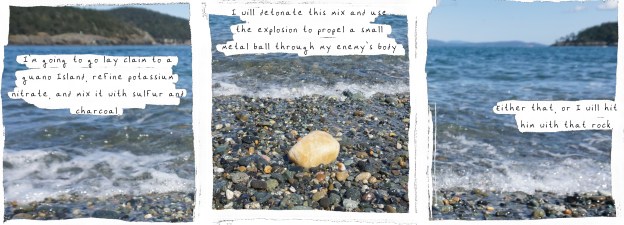
Ancient impulses with modern weapons are weird. I have this picture in my head of an angry person saying “I’m going to get that guy. I’m going to go lay claim to a guano Island, refine potassium nitrate, make black powder, and use an explosion to propel a small metal ball through his body.” Then the pre-modern human says “I’d just hit him with this rock. Simpler.”
I believe in public funding for science and especially revolutionary, high-risk/high-reward projects. Most of those projects will fail. That scares the funding agencies. It looks like a lot of wasted money. But I think that’s the price for innovation.
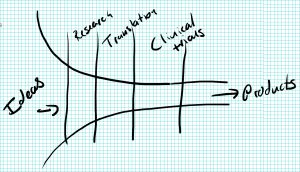
We need to fill the beginning of the pipeline with lots of good ideas. When something works, there will be plenty of motivation to move it down the pipe. There are big rewards at the end of the pipe. I think that’s great. I just want there to be more support at the beginning.
For projects that do have support (and not necessarily government support), I also see the little human weaknesses as a real problem holding back important projects. The two projects that come to mind are Open Source Ecology and Paul Wheaton’s Permaculture community.
This article (brilliantly titled The Post-Apocalypse Survival Machine Nerd Farm) reminded me of what it was like to live with roommates. Not everyone is equally motivated. Not everyone wants to volunteer their hours getting up early to build a DIY tractor. And not everyone knows that about themselves. It sounds amazing: sustainable agriculture, technical puzzles, building great things, sharing new technology with the world… Utopia! But the reality is pooping in a bucket and getting up at 6AM to troubleshoot a burst hydraulic line.
The Permies community ran into a similar issue. The Wheaton Labs Farm invited a bunch of people to come out and live and plant and experiment with sustainable agriculture. But people didn’t want to do dishes or do the hand towel laundry. A lot of the unsustainable parts of our culture are a direct result of our coping with these little irresponsible things. Why use paper plates and paper towels? Because nobody wants to take care of the dishes and laundry.
The bottom line is that there are natural resources and technology… but getting people to cooperate and do the unpleasant work is the hard part. That’s no surprise, I suppose. It’s just funny that the difference between utopia and dystopia… at the micro level… is doing the dishes.
I readan essay in the Chronicle about apocalyptic thinking that solidified some ideas that I have been unable to organize in my mind. The gist is that Apocalyptic thinking is really just egotism. For example, take when Harold Camping predicted the world would end. That was more narcissistic than anything else. I feel some tension when I make that judgment: although I laugh at his conceit, I still love dystopian fiction. That makes me a little narcissistic, too.




You must be logged in to post a comment.