Category Archives: Science

All things scientific

Organ-on-a-chip for safer drugs sooner

We need a new way to test drugs and supplements for safety. The current method is slow and uses animals. Nobody likes animal cruelty. Plus, animal biology is not exactly the same as human biology. There are unpredictable differences. Organ-on-a-chip is a way to culture human cells in a device that mimics the structure of an organ. The device is made of a clear plastic so that scientists can watch the cells under different conditions. If this approach works, it will allow for faster and more accurate safety tests without using animals.

By Timothy.ruban - Own work, CC BY-SA 3.0 - 2017-04-13 06_44_38-Conceptual Schematic of a Human-on-a-Chip - Organ-on-a-chip

Safety is critical. Before a drug enters human safety trials, it is tested on two species of animals. Even so, strange things can happen when moving to a new species. If a compound is not dangerous to rats or dogs, it can still be dangerous to people. BIA 10-2474 is such a compound: it killed a safety trial participant in France.  Conversely, theobromine is safe for humans but dangerous for dogs. If theobromine had been a drug candidate, and it had failed safety tests in dogs, it would have been regarded as too risky to try in people. This despite the fact that it is actually safe. Undoubtedly, there are safe drugs that have been rejected for reasons that are not applicable to people.

With an organ-on-a-chip approach, it may be possible to test drug candidates on human cells in a way that reports whether the compound is actually safe for humans. A 2010 paper in science talks about building a mini-lung that can be used to investigate whole-organ responses like inflammation. That’s not something that shows up in a simple tissue culture model; it requires multiple cell types and structures.

The FDA is now Testing ‘Organs-on-Chips’ Technology according to an FDA blog post:

On April 11, 2017, FDA announced a multi-year research and development agreement with a company called Emulate Inc. to evaluate the company’s “Organs-on-Chips” technology in laboratories at the agency’s Center for Food Safety and Applied Nutrition, one of a number of FDA efforts to help evaluate this chip technology. The flexible polymer organ-chips contain tiny channels lined with living human cells and are capable of reproducing blood and air flow just as in the human body. The chips are translucent, giving researchers a window into the inner workings of the organ being studied.

That’s encouraging. If the FDA determines that organ chips give results that are comparable or better than animal results, we might see lower regulatory hurdles for new drugs. Faster, better approvals are good for patients and investors. Plus, nobody likes animal testing.

Raspberry Pi Computer: standalone “safe” machine

I want a computer that does not rely on a software service agreement to function. Cell phones obviously have to operate as a service since they need a network to operate. The phone is a gateway to the cell service. My kindle is similar for Amazon services. Laptops feel different to me. Computers feel like products. I own my laptop and I want to think of it as a standalone device, not a gateway to a cloud service.

Windows 10 is now a service. The future is clearly going in the direction of software as a service (SaaS as the kids put it). That’s fine, but I like to have at least some device that can’t be remotely bricked by a company.

Raspberry Pi Computer in a Box parts list:

Quick catch-up for other topics this week: I made a video I about sodium-ion batteries and people seemed interested. I think a sodium ion battery would be really cool. But I think the expectations of the youtube viewers may be a little inflated. Sodium is heavier than lithium. It yields less energy per atom, too. So it’s not going to be great for mobile. I made another video talking about that. So why bother with sodium? Lithium is relatively rare and expensive… so sodium might be better for stationary applications. It’s hard to say at this point, but I’m investing my time in an iron battery.


Lithium ion batteries are not for DIY

Lithium ion batteries are in all kinds of high performance devices. I made a little video talking about how they work. They store a good amount of energy, release it fast enough for a cell phone, and don’t blow up all that often. Typically, lithium or lithium-ion batteries need to be assembled without the presence of water or oxygen which makes them less than ideal for DIY. The old potato battery with lithium is a bad idea.

What about sodium batteries? Sodium is another alkali metal like lithium. It should work similarly, but it’s way cheaper. You can buy sodium hydroxide for $8 a pound at the hardware store. That’s about half elemental sodium by mass. That’s an order of magnitude less expensive than lithium. The price per watt-hour stored could get considerably lower.  The lowest that prices can go is the price of materials, and sodium is cheap. For now, though, the cost of materials is not the biggest part of the final battery price. The cost of assembly, housing, and associated electronics is a bigger share of the pie, so it makes sense to work on those first.

What is not so good about sodium batteries? Sodium metal stores less energy per atom, so you get a lower voltage. It’s also a lot heavier, so you get less energy per unit mass. Sodium is more explosive in contact with water than lithium. It’s harder to pack into electrodes. Where graphite holds lithium and lets it migrate, the equivalent for sodium doesn’t work so well. As you charge a LiFePO4 battery, you move lithium into a graphite cathode for storage. Lithium slips between the layers of graphite, but sodium doesn’t fit.

If those problems could be overcome, sodium batteries would be great for stationary storage. Sodium batteries would be heavy (no good for mobile) but cheap (good for large scale). Aquion, Faradion, and GE are all working on it. Several articles from academic labs have come out very recently showing off sodium battery technology. So what are the major hold-ups? Two reviews talk about the issues, and they are all challenging.

I’m interested in iron batteries. Iron is cheap, ubiquitous, and I think the sheer volume of iron available may make it a good candidate for grid storage. So I’m playing with it a bit. Check out the vlog:

Index of refraction based detection

I had an idea to build an index of refraction-based detector for an electrophoresis set-up. When light passes through a prism, it bends. That’s how prisms cast rainbows. The angle at which the rainbow shows up depends on the material of the prism. If the prism is made of glass, you get a rainbow at one angle. If the prism is made of water, you get a different angle. We can use this phenomenon to detect changes in the material. We need a prism that we can fill with different materials. Then we can see how the angle changes. I built such a prism out of acrylic with my laser cutter. It looks like this:

2017-03-31 07_51_53-VID_20170331_065902.mp4

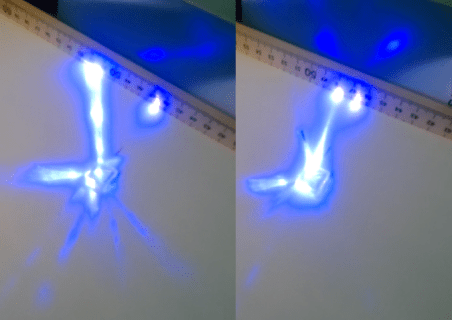
I haven’t started flowing things through the prism yet. I’m still figuring out how to detect the angle change. But there definitely is an angle change. I can see the difference in angle between when I have air in the prism and when I have water in the prism. Have a look – that’s air on the left and water on the right:

2017-03-31 07_46_01-VID_20170331_070040.mp4-combine

So now the question is how tiny a difference can I detect? Adding small amounts of sugar to the water will change the index of refraction a tiny bit. That should change the angle by a small amount as well. If I can measure the angle very precisely, I should be able to detect very small changes in the sugar content of the water.

I’ll try to get my students to build generation 2 of the device. Design, build, test learn. The work will teach them.

More droplet literature reading and a bit of a ramble

There is a neat paper in this issue of the journal Lab on a Chip. The Tuteja lab out of Michigan developed a clever way of making droplets using a laser cut jig and an open platform. I mean literally open (not like open source). They make water in oil droplets that float across the surface of a hydrophobic chip. It reminds me a lot of the beer sphere.

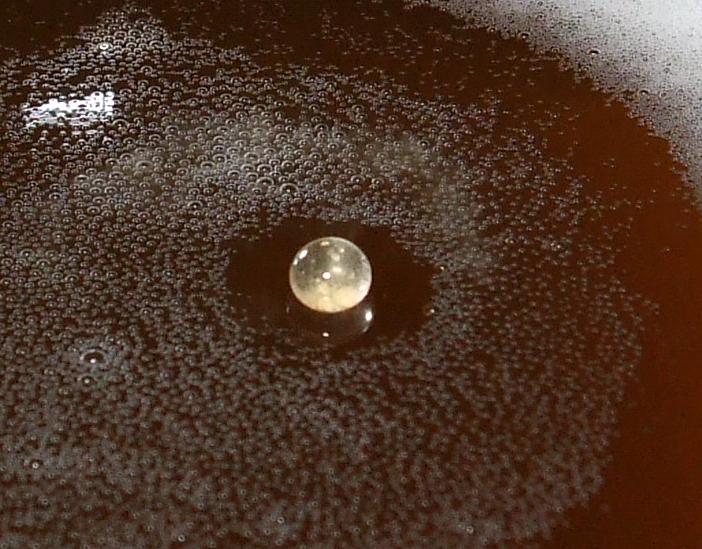
I caught this image of a beer sphere suspended on its surface tension on the surface of a glass of beer. It was so persistent that I was able to get my camera and come back to the table to take a picture.

The Slo-Mo guys got really good footage of surface tension droplets. It’s an interesting phenomenon. Surface tension prevents a water droplet from merging with the water surface. If you have an oil surface, the water will not merge at all. Surface tension isn’t needed. But it looks similar.

I meant to get in the lab this morning and fabricate some devices, but I am not feeling motivated. I ramble a bit about that in the video today. I’m very worried about science funding. That’s dumb. Can’t do anything about it. It’s worrying for nothing. But I am worrying anyway. That’s four hours of my life I will not get back.

Focus on science. Rise above.