Category Archives: Science

Acrylic microfluidics part 7

One of the reasons I am trying to develop these techniques for acrylic microfluidics is to shorten the design-build-test feedback loop. With the PDMS techniques I worked on and grad school the loop is about a week long. It takes a day to design, a few days to get the photomask, and a day or two to fabricate. If nothing goes wrong, I use to be able to get a design tested on day five.

With acrylic based microfluidics, the loop is much shorter. I can modify a design, cut it with the laser, fabricate the chip, and have it tested all within three hours. Three hours is a significant improvement over five days.

2017-03-28 07_43_58-Krita

This morning I came in and cut a new chip with some new parameters. I was hoping to see a narrower width channel which would produce smaller droplets. I didn’t get that, but I can try again (tomorrow not next week). Plus, I learned something. I need to add a viewing area to the chip to see the droplets better.

I made a little video of some of the process. I skipped the bonding step in the video because it’s just 10 minutes of waiting while the hot press does its work.

Here are parts 1 2 3 4, 5 and 6.

Droplet microfluidics with acrylic part 6

I’m just going to do a brief update today on the microfluidics project. We set out to make acrylic plastic microfluidic chips that could generate tiny droplets of water in oil. Eventually, I hope to use these droplets to make polymer particles. We can make polymer particles from a water in oil emulsion. We usually just shake the mixture vigorously to make the emulsion. But that makes all kinds of different sizes and causes other problems as well. So now we’re going to use a much more complicated method: microfluidics.

I have some experience with droplet based microfluidics. I worked on it in graduate school. It’s a simple idea. Flow oil and water through tiny tubes that merge into a single tube. This forces them to mix and they break up into little droplets. In practice, it can be pretty hard. One of the practical challenges is that it takes a stable flow rate to make homogeneous droplets. It can be a big challenge to get a stable flow. That’s especially true if your microfluidic chip is made of a stretchy material (I’m looking at you PDMS). It makes sense to move to a chip that doesn’t stretch at all like acrylic plastic.

I had a great undergraduate come in and work with me this weekend on creating droplets with an acrylic plastic microfluidic chip. I had this working a few months ago but with much bigger channels. My first success was with channels that were more like 1 mm wide. The droplets were close to 1 mm wide as well.

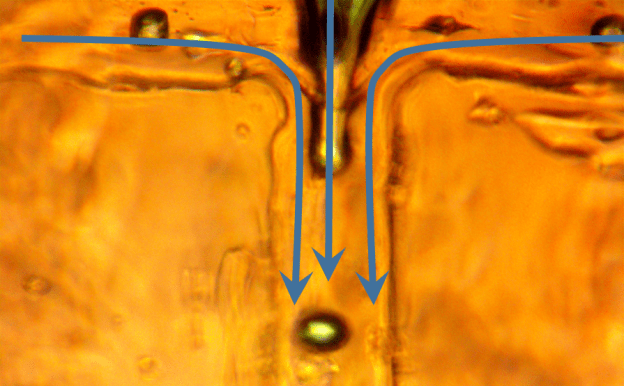
We set about to optimize a fabrication technique that would make smaller channels and then uses channels to make droplets. After much difficulty, we have succeeded. We are now making channels that are approximately 100 µm wide and making droplets that are approximately 50 µm wide.

2017-03-27 06_35_38-Presentation1 - PowerPoint

If you have an application that requires non-stretching microfluidic channels, please get in touch. We can send you one.

Here are parts 1 2 3 4, and 5.

The difference between utopia and dystopia is doing the dishes

I believe in public funding for science and especially revolutionary, high-risk/high-reward projects.  Most of those projects will fail. That scares the funding agencies. It looks like a lot of wasted money. But I think that’s the price for innovation.

2017-03-23 07_07_42-Krita

We need to fill the beginning of the pipeline with lots of good ideas. When something works, there will be plenty of motivation to move it down the pipe. There are big rewards at the end of the pipe. I think that’s great. I just want there to be more support at the beginning.

For projects that do have support (and not necessarily government support), I also see the little human weaknesses as a real problem holding back important projects. The two projects that come to mind are Open Source Ecology and Paul Wheaton’s Permaculture community.

This article (brilliantly titled The Post-Apocalypse Survival Machine Nerd Farm) reminded me of what it was like to live with roommates. Not everyone is equally motivated. Not everyone wants to volunteer their hours getting up early to build a DIY tractor. And not everyone knows that about themselves. It sounds amazing: sustainable agriculture, technical puzzles, building great things, sharing new technology with the world… Utopia! But the reality is pooping in a bucket and getting up at 6AM to troubleshoot a burst hydraulic line.

The Permies community ran into a similar issue. The Wheaton Labs Farm invited a bunch of people to come out and live and plant and experiment with sustainable agriculture. But people didn’t want to do dishes or do the hand towel laundry. A lot of the unsustainable parts of our culture are a direct result of our coping with these little irresponsible things. Why use paper plates and paper towels? Because nobody wants to take care of the dishes and laundry.

The bottom line is that there are natural resources and technology… but getting people to cooperate and do the unpleasant work is the hard part. That’s no surprise, I suppose. It’s just funny that the difference between utopia and dystopia… at the micro level… is  doing the dishes.


Utopian communities sharing their experiences online

I get the impression that there are not all that many people interested in Utopia (as a concept). Maybe we’re a bit more skeptical than folks were in the 1800s. Or maybe charismatic leaders just don’t gain so much traction in an era with electronic criminal records and background checks.

The good parts of living with room mates were really good. A built in social network and a always-on source of good conversation and affirmation? Yeah. Doing other peoples’ dishes… not so much.

I follow three projects with utopian visions:

Open Source Ecology

Paul Wheaton’s Permaculture community

Focus Fusion

I love that these folks are putting their experiences out there. It’s exciting to see folks trying to build something grand. It’s even interesting to watch the setbacks. I don’t know how much popular interest there is in this kind of thing.


I have decided to argue with the flat earth society

For better or worse I have decided to argue with the flat earth society today. I almost hate to rehash the arguments against something so silly. But I want to use these arguments against the flat earth society as an example to make a different point.

Point #1against the flat Earth: the size of the conspiracy would have to be vast. Every NASA engineer, every phone engineer, every astronomer: they would all have to be involved in hiding the truth of the flat Earth if such a thing existed.

Point #2 against the flat Earth: If you go to the equator, you can see stars appear to rotate around both poles. It’s hard to resolve that without having a North and a South Pole. If the earth is flat, there can only be one pole right in the center.

Point #3 against the flat Earth: Someone in Texas sees the sun rising while someone in Korea sees it setting. A little triangulation would put the sun right beneath the surface of the Earth in Africa. That seems… problematic.

Having established these points, I want to back up.

Engaging the flat earth society by drawing their attention to these problems will be entirely ineffective. In fact, it might backfire. If I pointed these facts out to someone who held flat earth beliefs, they would almost certainly decide that I was part of the conspiracy. As such, nothing I said could possibly be trusted.

I think that the problem is that I am claiming authority. I claim to know the truth and I claim that they are wrong. I seem to be a part of the Establishment. I seem to be trying to force them to believe something. If they resent my position of “power,” they will tend to be hostile to my claims.

I suggest the following hypothesis. Educators will be more effective in dispelling false beliefs by pointing out a different form of authority with students from a young age. I suggest that the only real authorities are observation and reason. Maybe this can reduce that resentment-of-authority phenomenon.