Category Archives: Science

All things scientific

I have decided to argue with the flat earth society

For better or worse I have decided to argue with the flat earth society today. I almost hate to rehash the arguments against something so silly. But I want to use these arguments against the flat earth society as an example to make a different point.

Point #1against the flat Earth: the size of the conspiracy would have to be vast. Every NASA engineer, every phone engineer, every astronomer: they would all have to be involved in hiding the truth of the flat Earth if such a thing existed.

Point #2 against the flat Earth: If you go to the equator, you can see stars appear to rotate around both poles. It’s hard to resolve that without having a North and a South Pole. If the earth is flat, there can only be one pole right in the center.

Point #3 against the flat Earth: Someone in Texas sees the sun rising while someone in Korea sees it setting. A little triangulation would put the sun right beneath the surface of the Earth in Africa. That seems… problematic.

Having established these points, I want to back up.

Engaging the flat earth society by drawing their attention to these problems will be entirely ineffective. In fact, it might backfire. If I pointed these facts out to someone who held flat earth beliefs, they would almost certainly decide that I was part of the conspiracy. As such, nothing I said could possibly be trusted.

I think that the problem is that I am claiming authority. I claim to know the truth and I claim that they are wrong. I seem to be a part of the Establishment. I seem to be trying to force them to believe something. If they resent my position of “power,” they will tend to be hostile to my claims.

I suggest the following hypothesis. Educators will be more effective in dispelling false beliefs by pointing out a different form of authority with students from a young age. I suggest that the only real authorities are observation and reason. Maybe this can reduce that resentment-of-authority phenomenon.
Open Source Scientific Hardware

I love the idea of using open source hardware for laboratories. As someone who likes to tinker with his instruments, open source makes a lot of sense. If I build a spectrophotometer from parts, and all of the parts are well documented, I can make modifications and repairs more easily. It also makes sense from a monetary standpoint: I don’t have to pay for lots of support and infrastructure that I don’t want or need.

That being said,  there are some disadvantages:  there is no service contract associated with an open source instrument. If I buy something and I don’t know how to use it or repair it and it breaks, then I am simply out of luck.

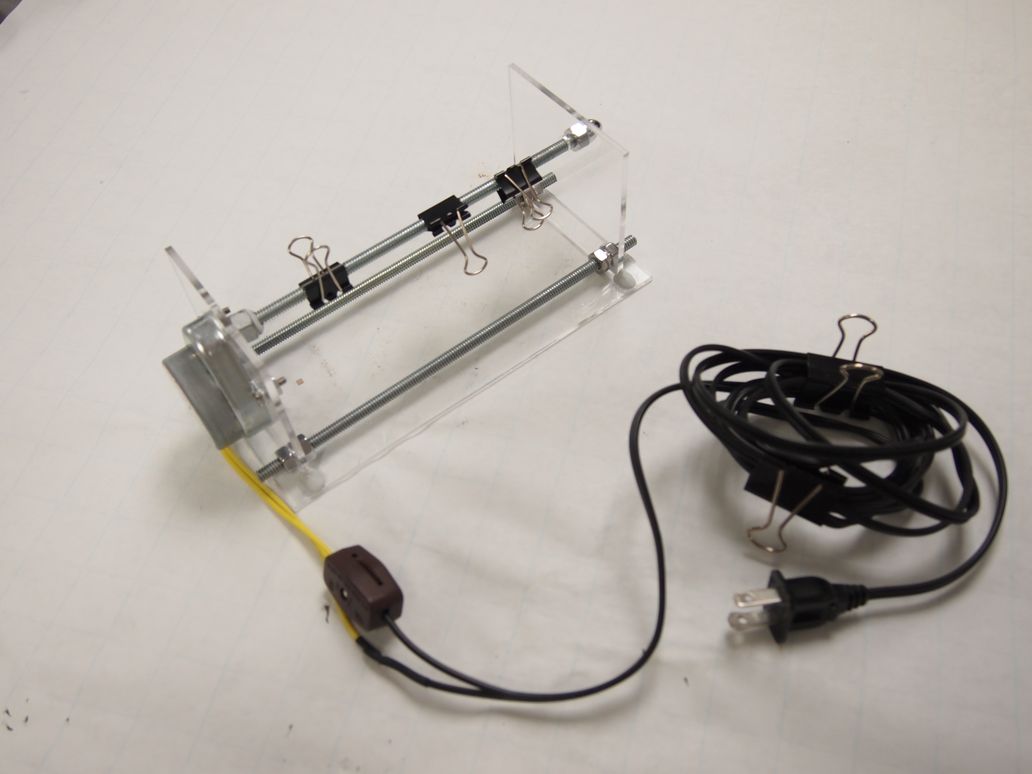
For now it makes the most sense to build simple instruments. I made an Open Source sample rotator for biology/chemistry laboratories. A new rotator for slowly stirring a solution during a reaction can be $300+ (Thermo wants you to request a quote!). I built one for about $50. The whole thing makes one rotation every 10 seconds. I secure vials to the rotating threaded rod using binder clips and/or tape.

OLYMPUS DIGITAL CAMERAIt works about as well as could be desired for a simple tool. There are lots of other examples. I published a short collection of others I made in the Journal of Biological Methods. There are some other great projects out there. One of my favorites is explained in a paper from the Pearce Lab at MTU. It was published in the Journal of Lab Automation. It talks about an open source liquid handling platform. The robots I had access to back in the day were just too intimidating – they were expensive and had a very steep learning curve. These will have a learning curve at first, but might at least be cheap.

Here are some other places that cover open source hardware:


Rotator Build notes:

I ordered the two square pieces and one rectangular piece of acrylic custom laser cut with appropriate holes from ponoko.com (CAD files are also available for cutting or downloading for modification). I also used one piece of threaded rod (.25 inch diameter, 20 threads per inch pitch) from the local hardware store. I cut that into three sections and used 9 nuts and 1 cap nut to secure it to the device. A attached the motor to the acrylic with two small machine screws I found in the lab. I locked the contact point between threaded rod and motor with epoxy paste. I solvent-welded the joints between the rectangle and squares with methylene chloride. I used a little bit of epoxy paste to reinforce the solvent-welded joints.

The switch, motor, and power cord were all ordered from McMaster Carr:

3867K12 Constant-Speed AC Gearmotor 6 rpm At 60 Hz  $23.57

14695K91 Inline on/Off Switch for Lamp  $ 2.64

7248K22 Power Cord with Two-Blade Plug 18 Gauge Wire, 9′ Long  $3.02

6 Month Review of the Scrum Method

The Allen Lab has using the Scrum method for 6 months. It is been remarkably productive. With two graduate students and three undergrads, we produced the data for two papers. One paper was submitted and provisionally accepted. The other is in preparation. We also produced a grant application.

The Allen Lab Scrum BoradThe Allen Lab Scrum Board

I give a lot of the credit for this to the Scrum method. I am new to lab management. My graduate students are very young and my undergraduates are just getting started. They have done amazingly and deserve the rest of the credit. I was not as productive in graduate school or in my postdoctoral work. I produced one paper per year (which is not bad) but this has been eye-opening.

It’s actually very difficult not to try to “convert” people. I feel almost like Scrum is a religion or something. I keep thinking about promoting this to other people in the department. I really don’t think that’s appropriate, so I keep my mouth shut. I’m the new kid and I am not a management consultant by any means. Every lab is different. I recognize all of this. Even so, I rather wish that I had trained in Scrum when I was a graduate student.

Maybe it would not have made much of a difference: there wasn’t a lot of “team science” when I was in graduate school. I don’t know if that’s a good thing or not. Maybe graduate students need more practice in team management. On the other hand, maybe it’s better to learn to do everything yourself. I don’t have a good answer for that, but I know what’s productive in my lab.

Amazon is inadvertently making sexy science

A hilarious thing happened about 2 weeks ago and now again today.

I wanted to build an instrument for making emulsions. Commercial equipment for generating emulsions can cost up to $10,000. I want to build something for more like $200. My ad hoc homogenizer could also be used to lyse cells or break up tissue. I want to use it to make polyacrylamide microspheres. I have some worries that the resulting microspheres will not be sufficiently uniform so it would be a shame to pay a huge amount of money for the equipment which might subsequently turn out to be useless.

Anyway, I need a reciprocating saw and some method to attach a micro-tube to the end of said reciprocating saw. Reciprocating saws run about $100. The adapter runs about $15. I can then 3-D print a micro-tube holder that will attach to the adapter. This all is looking fine.

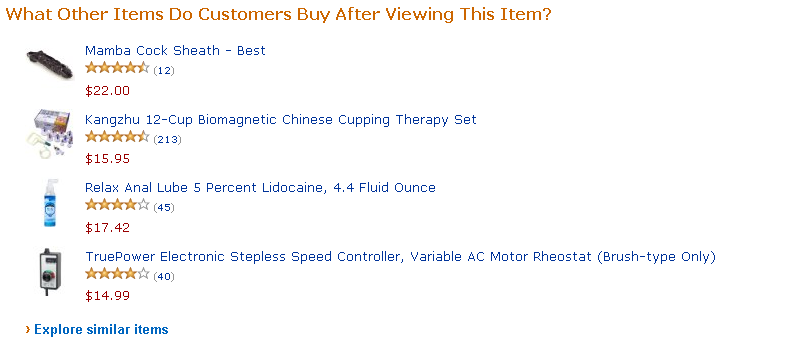
Here’s the hilarious part. In addition to attaching scrub brushes and metal files to the end of the reciprocating saw, this little adapter has (evidently) been used “frequently” to build makeshift sex toys. 2015-01-15 17_01_51-Reciprotools RCT-A10 Reciprocating Saw Adapter - Reciprocating Saw Accessories - 2015-01-15 17_02_19-Reciprotools RCT-A10 Reciprocating Saw Adapter - Reciprocating Saw Accessories -

Thank you, Amazon, for that fascinating view into the lives of my fellow customers. I did end up buying the speed controller, though. That was pretty insightful.

It happened again today.

2015-01-29 14_10_37-Amazon.com_ rocker platform

I wanted to order a “platform rocker” not “rocker platforms.” Keep making science sexy, Amazon.

I guess this is a common phenomenon: Amazon has been accidentally making starter kits for drug dealers, too. I noticed something along these lines when I purchased a little milligram balance. “Did you want rolling papers with that?” No, Amazon, I don’t. I don’t want rolling papers or spiky high heel boots. But it’s nice to know that you are so non-judgmental.

FNANO 2014 Conference Day 1

The morning session of FNANO consisted of a suite of presenters who discussed their photonics and self-assembly techniques. Ralf Jungmann talked about the DNA-PAINT technique which I find really remarkable. The idea is strange: transient interactions + fuzzy pictures + math = sharp pictures.

One can image a single molecule with fluorescence microscopy (this has been done for 20 years) but the details get lost. It just looks like a cloud and it doesn’t matter how good a microscope you use. It will always be a cloud. DNA-PAINT is designed to generate such clouds over and over. By carefully analyzing the series of transient fuzzy clouds, a computer can find their exact centers. By comparing the centers of all of the clouds (which overlap but appear at different times; I said it was weird) the computer can construct an image that is waaay below the limit of normal microscopes. I love it and want to try it.

Yan Liu and Philip Tinnefeld both talked about using carefully arranged metal structures to have a strong impact on how light interacts with matter. For instance, two metal nanospheres on either side of a fluorescent molecule make that molecule considerably brighter – like hooking it up to an antenna. Some thought was given to the relationship between humans new entry into engineering on the scale of light-waves, and how biology has been doing it for billions of years to accomplish photosynthesis. I think it will be hard to compete with nature in this arena, but I think it’s a wonderful enterprise.


In the afternoon session I got to hear mostly about non-biological self-assembly. One talk by Lee Cronin stood out. He makes nano-scale objects that are not made from DNA. That was an interesting change. Almost everything else has been DNA. His structures are not as designable in terms of shape and tend to be much more symmetrical. Still, his approach holds special appeal to me. He made a liquid handling robot out of a 3D printer that iterated hundreds of experimental self-assembly conditions in order to find an optimum. I did something similar a few years ago. I think that robotic approaches to the experimental work are a great way to do science without going crazy. Robots can generate a rich, reproducible dataset that can then be mined for interesting features.

Credit Cronin Group

Credit: Cronin Group