Category Archives: Science

6 Month Review of the Scrum Method

The Allen Lab has using the Scrum method for 6 months. It is been remarkably productive. With two graduate students and three undergrads, we produced the data for two papers. One paper was submitted and provisionally accepted. The other is in preparation. We also produced a grant application.

The Allen Lab Scrum BoradThe Allen Lab Scrum Board

I give a lot of the credit for this to the Scrum method. I am new to lab management. My graduate students are very young and my undergraduates are just getting started. They have done amazingly and deserve the rest of the credit. I was not as productive in graduate school or in my postdoctoral work. I produced one paper per year (which is not bad) but this has been eye-opening.

It’s actually very difficult not to try to “convert” people. I feel almost like Scrum is a religion or something. I keep thinking about promoting this to other people in the department. I really don’t think that’s appropriate, so I keep my mouth shut. I’m the new kid and I am not a management consultant by any means. Every lab is different. I recognize all of this. Even so, I rather wish that I had trained in Scrum when I was a graduate student.

Maybe it would not have made much of a difference: there wasn’t a lot of “team science” when I was in graduate school. I don’t know if that’s a good thing or not. Maybe graduate students need more practice in team management. On the other hand, maybe it’s better to learn to do everything yourself. I don’t have a good answer for that, but I know what’s productive in my lab.

Amazon is inadvertently making sexy science

A hilarious thing happened about 2 weeks ago and now again today.

I wanted to build an instrument for making emulsions. Commercial equipment for generating emulsions can cost up to $10,000. I want to build something for more like $200. My ad hoc homogenizer could also be used to lyse cells or break up tissue. I want to use it to make polyacrylamide microspheres. I have some worries that the resulting microspheres will not be sufficiently uniform so it would be a shame to pay a huge amount of money for the equipment which might subsequently turn out to be useless.

Anyway, I need a reciprocating saw and some method to attach a micro-tube to the end of said reciprocating saw. Reciprocating saws run about $100. The adapter runs about $15. I can then 3-D print a micro-tube holder that will attach to the adapter. This all is looking fine.

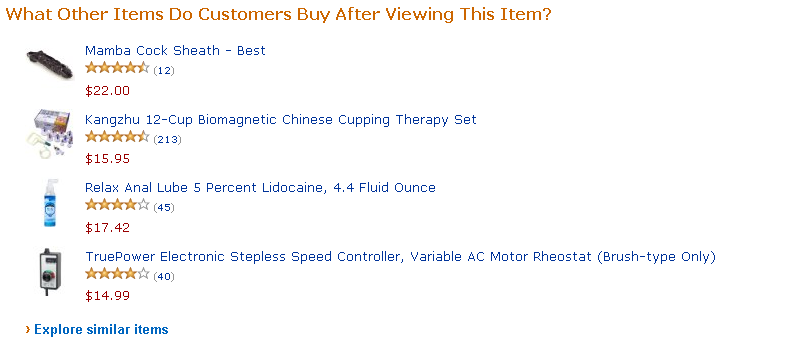
Here’s the hilarious part. In addition to attaching scrub brushes and metal files to the end of the reciprocating saw, this little adapter has (evidently) been used “frequently” to build makeshift sex toys. 2015-01-15 17_01_51-Reciprotools RCT-A10 Reciprocating Saw Adapter - Reciprocating Saw Accessories - 2015-01-15 17_02_19-Reciprotools RCT-A10 Reciprocating Saw Adapter - Reciprocating Saw Accessories -

Thank you, Amazon, for that fascinating view into the lives of my fellow customers. I did end up buying the speed controller, though. That was pretty insightful.

It happened again today.

2015-01-29 14_10_37-Amazon.com_ rocker platform

I wanted to order a “platform rocker” not “rocker platforms.” Keep making science sexy, Amazon.

I guess this is a common phenomenon: Amazon has been accidentally making starter kits for drug dealers, too. I noticed something along these lines when I purchased a little milligram balance. “Did you want rolling papers with that?” No, Amazon, I don’t. I don’t want rolling papers or spiky high heel boots. But it’s nice to know that you are so non-judgmental.

FNANO 2014 Conference Day 1

The morning session of FNANO consisted of a suite of presenters who discussed their photonics and self-assembly techniques. Ralf Jungmann talked about the DNA-PAINT technique which I find really remarkable. The idea is strange: transient interactions + fuzzy pictures + math = sharp pictures.

One can image a single molecule with fluorescence microscopy (this has been done for 20 years) but the details get lost. It just looks like a cloud and it doesn’t matter how good a microscope you use. It will always be a cloud. DNA-PAINT is designed to generate such clouds over and over. By carefully analyzing the series of transient fuzzy clouds, a computer can find their exact centers. By comparing the centers of all of the clouds (which overlap but appear at different times; I said it was weird) the computer can construct an image that is waaay below the limit of normal microscopes. I love it and want to try it.

Yan Liu and Philip Tinnefeld both talked about using carefully arranged metal structures to have a strong impact on how light interacts with matter. For instance, two metal nanospheres on either side of a fluorescent molecule make that molecule considerably brighter – like hooking it up to an antenna. Some thought was given to the relationship between humans new entry into engineering on the scale of light-waves, and how biology has been doing it for billions of years to accomplish photosynthesis. I think it will be hard to compete with nature in this arena, but I think it’s a wonderful enterprise.


In the afternoon session I got to hear mostly about non-biological self-assembly. One talk by Lee Cronin stood out. He makes nano-scale objects that are not made from DNA. That was an interesting change. Almost everything else has been DNA. His structures are not as designable in terms of shape and tend to be much more symmetrical. Still, his approach holds special appeal to me. He made a liquid handling robot out of a 3D printer that iterated hundreds of experimental self-assembly conditions in order to find an optimum. I did something similar a few years ago. I think that robotic approaches to the experimental work are a great way to do science without going crazy. Robots can generate a rich, reproducible dataset that can then be mined for interesting features.

Credit Cronin Group

Credit: Cronin Group


What can we really do about peak oil and global warming?

If you want to solve global warming, here is the method: help solar to beat the price per kilowatt-hour of natural gas. I think it can happen.

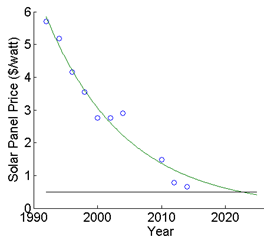
Consider the future of solar power. The price of panels is dropping quickly. A price of $0.50 per peak watt would have been absurdly optimistic a few years ago but it is now a virtual certainty. While solar panels may not advance as rapidly as Moore’s Law (as I read recently) they still fall in price by a significant margin every few years. I got my price data from renewableenergyworld.com. After removing the points from 2006-2008 because those years were hit hard by a silicon shortage, the data actually fit an exponential decay reasonably well.

 matlab_solar_energy_calcs

This graph shows the price of solar panels (blue circles) and an exponential fit to these data (green line). The black line indicates $0.50 per watt.

Continue reading

Conference on DNA Computing Liveblog Final notes

I hope my liveblog of DNA 19 was amusing. There were a lot of great talks. People seemed to think mine was interesting. I have to say that Peng Yin and the members of his group stole the show a bit. DNA bricks and the superresolution microscopy were really beautiful, plus he is involved in the RNAi applications (with Niles Pierce and others) which are very exciting. I think that was absolutely incredible. But the nanopore was probably my favorite structure (from the Simmel lab). All in all, I learned a lot and was very grateful to participate.