Category Archives: Uncategorized

Curiosity and Utility, justifications for science

I saw this Science News report on the analysis of how elephants are able to manipulate delicate things with their heavy trunks. At the end of it, the report talks about some justifications for why this information might be useful. For instance, a trunk-like robotic manipulator might be useful for search and rescue.

I think that might end up being useful, but I’m also just curious. How does the elephant do it? I want to know. The trick seems to be “virtual joints” that the elephant adjusts up or down the trunk length to support more or less of the trunk’s weight. That allows the trunk to be used for coarse or delicate tasks as necessary. That’s just clever.

I spend a lot of time trying to find a problem to solve. I think that the bio-detector particles that I am making in the lab will be useful for measuring biochemicals like cytokines. I think that measuring cytokines early and often will be useful for medicine. It turns out that there is significant diversity among humans in their baseline cytokine expression levels. So just knowing what is a normal, average expression level for one of these proteins is not good enough. To make sense of the data, we need individualized, normal, baseline measurements. Then we need to look for changes in a particular person’s levels that would indicate disease. And, ideally, we would have all of that data cross referenced with clinical outcomes. That way, every change could be interpreted in the light of as much data as possible. I think my research can help enable this kind of medical “big data” project.

Sometimes wish I could do this research just because it is cool. Just because I am curious if these particles can be made to talk to one another. Just because I want to see how far I can push the idea of a computational particle entity. I appreciate the needs of medicine, and I want to contribute, but I wonder why our culture seems so reluctant to support pure curiosity?

Diffraction grating and scattered light

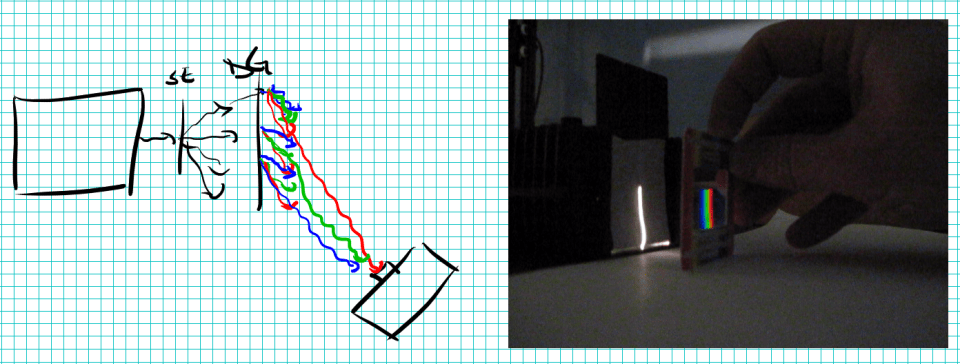
A few days ago I showed the early results for the spectroscopy demonstration I’m working on for my instrumental analysis class. I passed scattered light and collimated light (using an educational kit from Amazon) through a diffraction grating (also from Amazon) and showed that the results were very different. I posed the question in my vlog for my students: why does the scattered light show up as an image of a rainbow while collimated light shows a rainbow projected onto the paper in front of the grating?

Here’s the answer (if you don’t want to watch the answer in video form). collimated beams create a set of collimated rays of different colors which scatter from the paper.

2017-01-11 05_29_03-Krita.png

Scattered light can be seen at different angles through the diffraction grating from the same location, so looks like an image of a rainbow.

2017-01-11 05_28_42-Krita.png

For a more thorough explanation, I hope you’ll check out the video.

In other news, a Science News report brought my attention to a hand centrifuge capable of 100,000 rpm. The original paper in Nature from the Prakash lab at Stanford is everything I love about open source science. It’s thorough, beautifully presented, and easily replicable.


Rant about the anti-vaxxers

I ended up ranting a bit in a vlog about anti-vaxxers. The person who started the current brouhaha was a Cleveland doctor who was advising his online readers to avoid “toxins.” Most of the time, talk of “toxins” is really about a superstitious moral purity. This person has the same superstitious aversion to formaldehyde that some religions have about certain foods. It’s not about physical harm (because harm is demonstrably absent). So it must be about some other principle.

Formaldehyde is toxic at high doses. So is salt. So is oxygen. Formaldehyde is produced at some level by the human body as a metabolite. The question is: what is the dose? Any doctor should know that the dose makes the poison.

2017-01-10 09_09_39-Krita.png

Different compounds have different effects at different concentrations. Medical decisions should be made based on data not based on some vague superstition that chemicals are bad.

I gather that he is being disciplined by his employer. That’s something.


First pass at a spectroscopy demonstration

Last year, when I taught instrumental analysis, I gave very conventional lectures. This year, I would like to try to build and simulate instruments instead of just talking about them. With that in mind, I bought a light box from amazon that I can use for several projects. I hope to build a spectrophotometer and a fluorimeter at least. Maybe I can also build some demonstration equipment for electrochemistry. Plus, this gives me the opportunity to teach simulation.

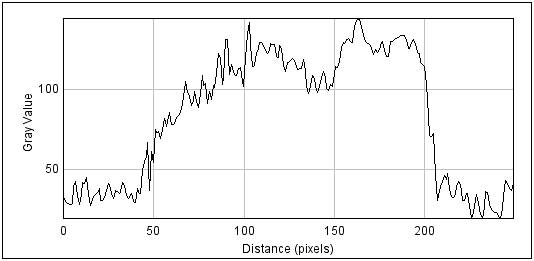
I made a short video about my first challenge to my students. I placed a diffraction grating in front of the light from a diffuser in front of a slit. The results was a nice rainbow. I used ImageJ to take a line scan. That’s one way to get to a spectrum.

2017-01-09-08_46_15-img_1610-crop-jpg

2017-01-09 08_42_51-Plot of IMG_1610-crop.png

The optical components need to be locked into place, the distance in pixels need to be calibrated to wavelength, and the sensitivity won’t ever be great, but I think it will be adequate to show some principles of spectroscopy. And it will definitely be adequate to show how light gets transformed to digital data and how that data can be processed.


Sodium battery news and particles

I’ve been interested in earth abundant battery materials since I saw Sadoway’s TED talk. The idea is to start with the earth abundance of elements and choose something from the top.

In this graph (credit wikimedia), the elements in the upper left are the ones we want to focus on. These are elements that are easy to find. They are cheap as rocks. Because rocks are made of them. That’s what we want to make our battery out of.

These batteries will not be high performance. Think tractor not Tesla. When it comes to performance, lithium is great. It gives a lot of energy per unit mass (because it is light and reactive). Lithium is about 800 times less abundant than sodium. Sodium is heavier and less reactive so the performance is lower. Maybe sodium is ten times less useful as a battery. But if it’s 800 times cheaper, it still wins for applications where price is the bigger issue.

There’s a nice article about a new sodium metal battery technology in ACS Central Science. The article talks about making a better battery by suppressing dendrite formation. The battery has a sodium metal anode, a CPMEA polymer barrier to prevent dendrite formation, an ion-conductive NASICON ceramic separator, then a titanium phosphate/CPMEA polymer cathode that can absorb the sodium ions.

I had not read up on the NASICON ceramic sodium conductor before. It’s an interesting material in its own right. It has been studied since the 60s and is not too hard to prepare. I’m not sure I understand the need to add the ceramic membrane, though, since the CPMEA polymer may conduct sodium already? I would like to try making a suspension of NASICON powder in pre-polymer and then polymerizing it. I wonder if that would make a decent membrane. It might be easier to manufacture than a sintered disc? Maybe I’ll see if I can work with an inorganic chemist to try it.

If someone out there has some Na1+xZr2SixP3-xO12 they would like to share, I’ll make you a polymer membrane with it!

In Allen lab News, I was able to make some particles with my microfluidic droplet generator. Now, today, I’ll see if I can make them homogeneous.

imageData_024216WG-summary.png

They look like this. Not very homogeneous yet.

If you want to hear me yak about all of this, you can catch me on the youtube: